American Akita
Coat
Solid:


Grizzle: Grey or Red grizzle (regular or sooty).
Sable: Red sable in any pattern is accepted.
Brindle:
with striping.
Masking: Any of the above colours may be masked with (standard or extended mask - mask may include whole head).
Masked dogz may have 'etching' which is a thin line of as tipping or solid as trim between the white and coloured areas.
Urajiro: All of the above may have urajiro.
White Markings:  is allowed on the above colours in any amount, the head must be mainly coloured in all patterns.
Symmetrical markings preferred.
Solid is also allowed, these dogz may have ears.
Ticking/Roaning: Ticking allowed.
Eyes

Nose

White dogz may have  , but black is preferred.
Faults
None
Disqualifications
Flesh nose in a dog that is not white.
Solid white head in a patched dog.
Blue striped brindle.
Notes
The Akita originates from the northern parts of the Japanese island Honshu, and has been close to extinction several times. It was originally a medium-sized hunting dog ('akita matagi' - 'good hunter') that was also kept as a fighting dog. Around 1868, it was crossed with Tosa Inus and similar breeds, which made the breed larger and heavier and therefore better adapted to fighting. The dogs were so highly valued that it was illegal to not bow when one passed by!
When dog fighting was made illegal in 1908 the Akita gradually became mixed up with other breeds, and in 1931 the breed was proclaimed a national symbol to ensure that it was preserved. However, during WWWI, only German Shepherds used by the military were allowed to be kept in the country, and as a result many Akita owners crossed their dogs with this breed. The few surviving Akitas after the war had been divided into three distinctive types; Akita Matagi, fighting dog Akita, and German Shepherd Akita. The heavier German Shepherd-type is the one that was exported to the USA, and is found there today, while the lighter and more Shiba-like Akita Matagi is preferred in Japan.
The Akita should be a large proportionate dog, somewhat rectangular with a lot of substance, elegant and majestic. he head is broad with a powerful muzzle. The ears are small and rounded. The body is strong with a deep chest and straight back. The tail is set high and carried in a curl over the back.
Breed Files
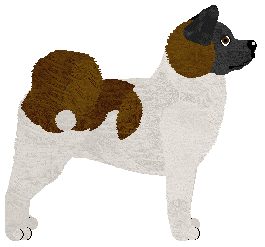
Abnormality V3
Filename: Japanese AkitaOffset: 63BA
Base: Great Dane
SCP: Great Dane
Accepted: December 22, 2011
Notes: 4 tail variations, 3 tuck-up variations.
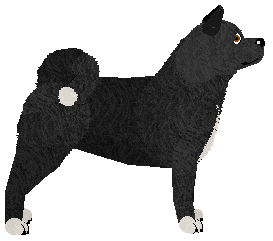
Supernova
Filename: American AkitaOffset: 1521
Base: Great Dane
SCP: Dalmatian
Accepted: May 19, 2011
Notes: 2 tail variations, optional nails and liplines.
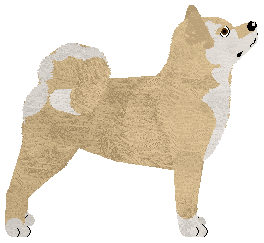
Lotus/Abnormality
Filename: Japanese AkitaOffset: 63BA
Base: Great Dane
SCP: Great Dane
Accepted: January 23, 2010
Notes: Joint project with Lotus of Abnormality. Includes four tail variations, two hind leg angulation variations and optional liplines.
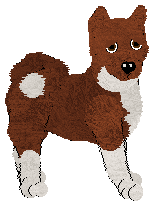
Abnormality V1
Filename: Japanese AkitaOffset: 63BA
Base: Great Dane
SCP: Great Dane
Accepted: April 1, 2006
Notes: -
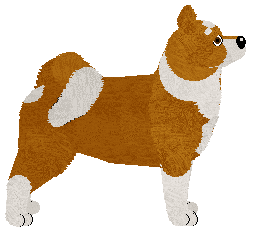
Abnormality V2
Filename: Japanese AkitaOffset: 63BA
Base: Great Dane
SCP: Great Dane
Accepted: April 1, 2006
Notes: Version 2 of the Abnormality file. Angled legs, addball tail. May be unsuitable for obedience.
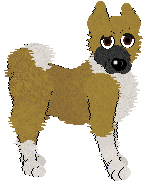
Faerie Barn Dance
Filename: RDK AkitaOffset: A297
Base: Great Dane
SCP: Great Dane
Accepted: January 4, 2006
Notes: -
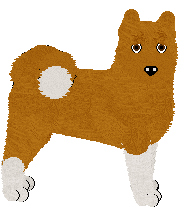
Pheonix Blaze
Filename: AkitaOffset: C303
Base: Great Dane
SCP: Great Dane
Accepted: February 11, 2005
Notes: Addball tail and slightly angled legs. Tail may fall on either side of the body and white tail tip may be obscured in pose.
