Masking
General
Masking refers to the canine-only pattern where the muzzle is covered by dark colour - usually black, but liver/blue/isabella may also be accepted. See the individual breed standard for allowed pigment types.
The size of the mask can vary within and between breeds, and we have split them into a few categories. The breed standard will mention which type of mask is accepted - if it says only "mask" without specifying which type, assume that any type is accepted.
When having the ears masked, they are allowed to have grizzled edges starting at base of ears to allow a better blending between the ear and the head colour. In breeds with long hair on the entire ear (Afghan Hound, Saluki, etc), the tips of the ear may be masked and the rest of the ear the head colour.
Unless otherwise stated in the standard, the mask must be complete and symmetrical.
Masking appears above base coat patterns (eg. solid, brindle, sable, merle etc.) and additional coat patterns (eg. tan, urajiro), but always below white spotting.
Small mask
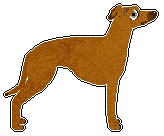
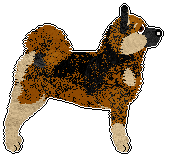
Similar to standard masking, but with less masking color in each area. Any amount of masking between the specified minimum and maximum markings are allowed.
Minimum masking: Roughly half of the muzzle, starting at the nose tip
Maximum masking: Rest of the muzzle, up to but not including the cheeks. A small cheek spot may be present on each cheek. Masking may also be present as a small spot above each eye, on the ear tips, and on the tail tip
 |
 |
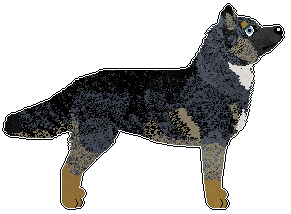 |
| A chocolate sable dog in with shading in the minimal pattern and a small mask in the matching liver pigment | A red sable dog in with shading in the maximum pattern, with urajiro markings and a small mask in the matching black pigment (please note that the solid ears seen here are part of the sable pattern, not the mask - fully masked ears would fall under the standard mask standard, rather than small | A grey grizzle dog with medium shading and trim markings, with white in the trim pattern and a small mask in the matching black pigment |
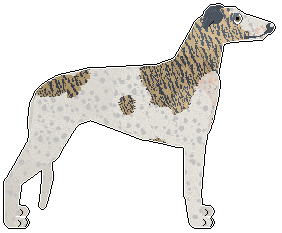
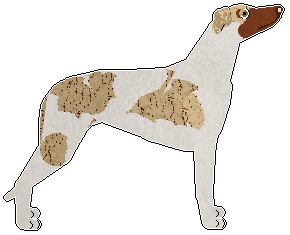
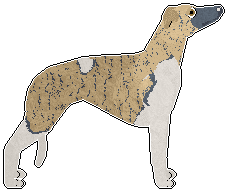
Standard mask
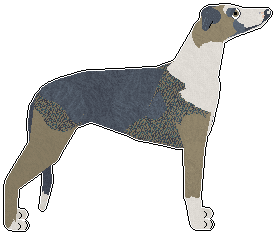
The most common type of masking.
Minimum masking: The whole of the muzzle
Maximum masking: A cheek spot on each cheek or the whole cheek can be dark. Masking may also be present on the whole of the ears, eyebrows, tail tip, and as spectacles around the eyes. The mask may reach from the muzzle up to the eyes, but not higher on the face
 |
 |
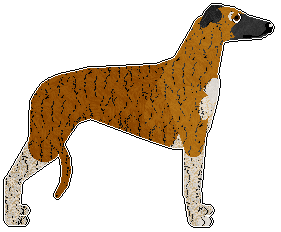 |
| A blue sable dog with shading in the classic pattern, with white in the irish spotting pattern and a standard mask in the matching blue pigment. Pigment spotting is also present on the white of the muzzle. | A blue brindle dog with white in the piebald pattern and a standard mask in the matching blue pigment. Pigment spotting is also present on the white over the entire dog | A black brindle dog with urajiro, white in the trim pattern, and a standard mask in the matching black pigment |
 |
 |
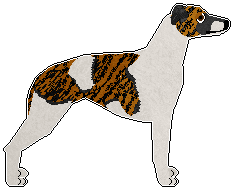 |
| A liver brindle with white in the piebald pattern and a standard mask in the matching liver pigment | A blue brindle with white in the irish spotting (relaxed) pattern and a standard mask in the matching blue pigment. Also note that this dog features etching - this is where a thin line of the masking colour is present between the white and the coloured areas in masked dogs. Check individual breed standards to see whether this is acceptable for your dog's breed. | A black brindle with white in the piebald pattern and a standard mask in the matching black pigment. Also note that this dog features etching - this is where a thin line of the masking colour is present between the white and the coloured areas in masked dogs. Check individual breed standards to see whether this is acceptable for your dog's breed. |
 |
 |
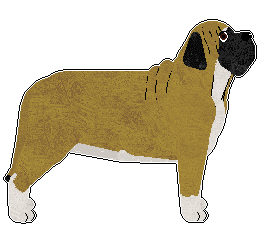 |
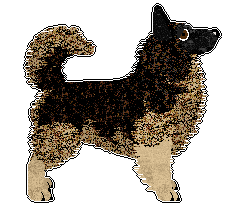
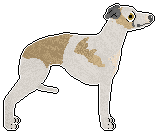
| A red sable with shading in the maximum pattern and a standard mask in the matching black pigment | A solid cream dog with white in the piebald pattern and a standard mask in a blue pigment | A solid tan dog with urajiro and a standard mask in a black pigment |
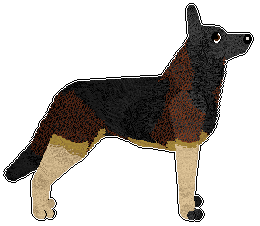
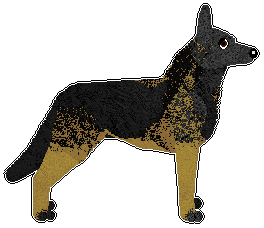
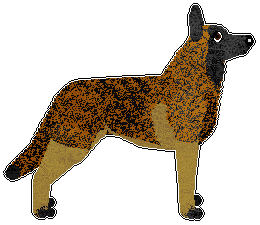
Extended Masking
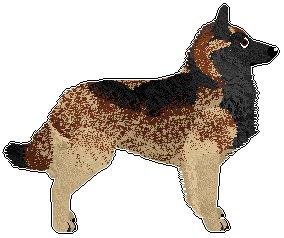
Extended masking allows the same markings as standard masking, but the mask may go up and surround most or all of the face and/or extend down on the front of throat/chest.
Some breeds with extended masking may also allow dark toes/fingers, but this will be listed in the standard if allowed. Likewise, a few breeds allow the whole head to be dark, and this will be listed in the standard if allowed.
Note that all the examples below are Belgian Shepherds, where both dark toes/fingers and a dark whole head are allowed.
 |
 |
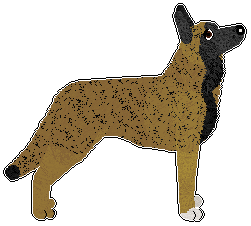 |
| A red sable dog with shading in the maximum pattern and an extended mask in the matching black pigment | A red sable dog with shading in the maximum pattern and an extended mask in the matching black pigment | A red sable dog with shading in the maximum pattern, white in the trim pattern and an extended mask in the matching black pigment |
 |
 |
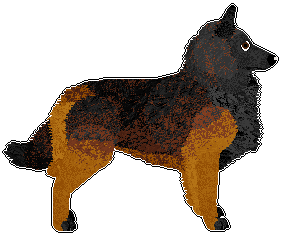 |
| A red sable dog with shading in the classic pattern and an extended mask in the matching black pigment | A red sable dog with shading in the maximum pattern and an extended mask in the matching black pigment | A red sable dog with shading in the maximum pattern and an extended mask in the matching black pigment |
