Sable
General
Sable is a canine-only pattern that is related to both tan point and grizzle. The name comes from a species of marten that is also named sable, famous for its valuable brownish, black-tipped fur. A sable dog is essentially a tan dog with darker shading, which can range from almost non-existent, to covering most of the dog, as well as anything inbetween.
Accepted Combinations
The following are the accepted sable combinations. If using palettes, these swatches show rough ballparks for accepted colours - remember it is up to the stewards' discretion as to whether they think the colours you use are accurate enough representations of the swatches below. Some breeds may allow additional base colours - check the individual breed standards for guidance on this.
Please note that red sable is, from a genetic viewpoint, a black-based sable. The name is based on how it appears rather than genetics, unlike the other types of sable.
| Sable | One Base Colour | Any Number of Shading Colours (Arranged Lightest -> Darkest) | Pigment Family |
|---|---|---|---|
| Red |


|


|
Black |
| Blue |
|


|
Blue |
| Chocolate |
|
|
Liver |
| Isabella |
|

|
Isabella |
Shaded fur can be depicted four different ways:
- Tipped shading colour over the base colour
- Tipped shading colour over a lighter shading colour
- Solid shading colour
- A darker shade of the base colour (i.e. 109 shading where the base colour is 100)
In addition, two or more shading colours (present in any of the above three forms) can be combined to show a gradual effect. There are too many possible combinations to list them all, however the following requirements must be met:
- All of the shading colours must be darker than the base colour
- The uppermost areas of the dog must be darker than the lowermost. Shading 'flows' from the ears, base of skull, side of head, spine, withers, tailtip over the rest of the dog. These areas do not have to be shaded to the same extent (e.g. the ears could be darker than the tailtip), but must be the same colour or darker than adjacent fur. For example, if the main part of the tail is shaded in 95 on a Red Sable, the tail tip must be 95, 95 tipped with 35, or 35 - the tailtip can't be any lighter than the rest of the tail
- The combination must be realistic - for example, take care combining cool colours and warm colours as they may clash unrealistically in certain arrangements
Please note for tails - when tails have more than one colour on them, the topside is dark and the underside is light. This remains so even if the tail is curled - in curled tails, the lighter underside will be facing the ceiling and the dark topside will be facing the floor.
The Sable Pattern
The sable pattern has been split into several groups of varying amounts of shading. If the breed standard doesn't specify which one/s are accepted, assume that all of them are. Some variation is usually allowed within each pattern - see the text description to see exactly what markings are allowed.
When a breed accepts degrees variations of sable, markings may be between the maximum shading for the lighter variety and the minimum for the heavier variety. The overall appearance should also appear to be within the two varieties.
Clear
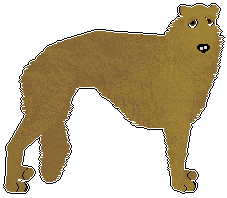
Shading is non-existent. These dogs appear solid, and sometimes the only way to distinguish whether a dog is sable or solid is by the pigment of the dog (i.e, the nose and eye colour).
 |
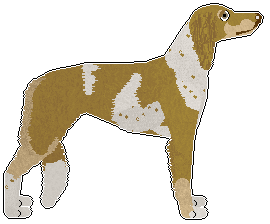 |
| A red sable dog with shading in the clear pattern | A chocolate sable dog with shading in the clear pattern, urajiro markings and white markings in the irish spotting pattern, with medium ticking present on the white. Here, the pigment (liver) gives away that the dog is sable, not solid - a solid tan saluki would have black pigment, in accordance with the breed standard |
Minimal
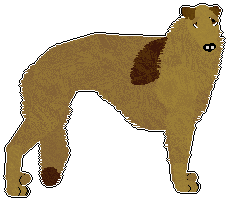
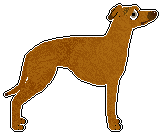
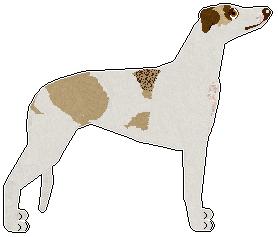
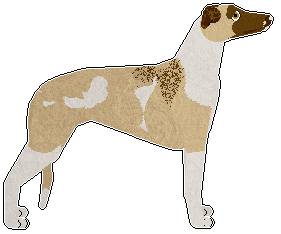
Found on one, several or all of the following: Ears, base of skull and/or side of head, spine and/or withers, tailtip.
 |
 |
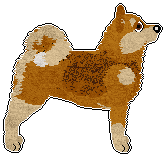 |
| A red sable dog with shading in the minimal pattern | A chocolate sable dog in with shading in the minimal pattern and a small mask | A red sable dog with shading in the minimal pattern, with urajiro markings and white in the trim pattern |
 |
 |
|
| A chocolate sable dog with shading in the minimal pattern, white in the piebald pattern, a standard mask and pigment spotting | A chocolate sable dog with shading in the minimal pattern, white in the piebald pattern, and a standard mask |
Classic
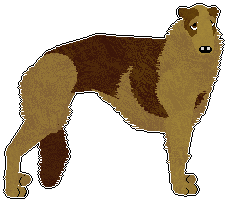
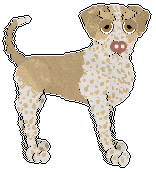
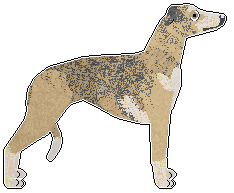
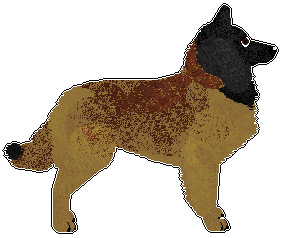
Shading is present on the ears, upper body, and tailtip. May also be found on one, several, or all of the following: head (except lower muzzle), neck, rest of body, rest of tail, shoulders, hips.
 |
 |
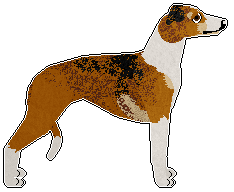 |
| A red sable dog with shading in the classic pattern | An isabella sable dog with shading in the classic pattern, white markings in the blanket pattern and heavy ticking present on the white. Here, a darker shade of the base colour is used to represent the shading. Note that this is not an a-reg accepted pattern in dalmatians | A red sable dog with shading in the classic pattern, urajiro markings and white in the irish spotting pattern |
 |
 |
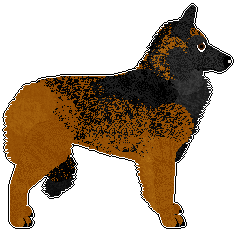 |
| A blue sable dog with shading in the classic pattern, urajiro markings and white in the trim pattern | A red sable dog with shading in the classic pattern and an extended mask | A red sable dog with shading in the classic pattern and an extended mask |
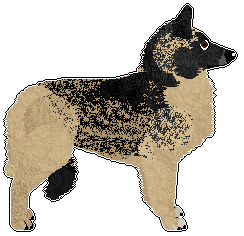 |
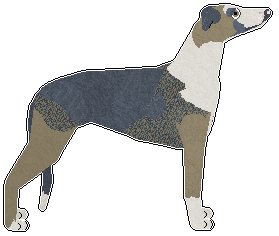 |
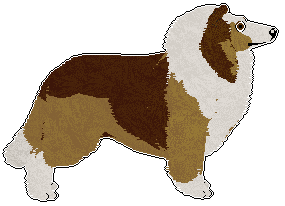 |
| A red sable dog with shading in the classic pattern and an extended mask | A blue sable dog with shading in the classic pattern, white in the irish spotting pattern,a standard mask and pigment spotting | A red sable dog with shading in the classic pattern and white in the irish spotting pattern |
Maximum
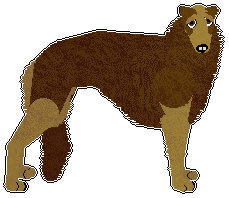
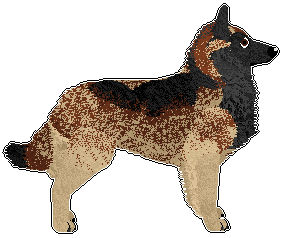
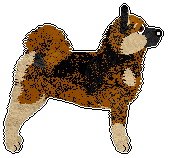
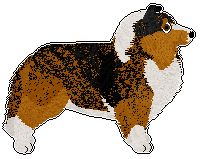
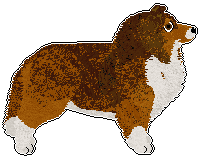
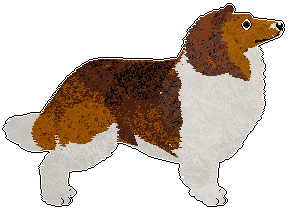
Shading covers up to the whole dog except for the following areas which must always remain tan: Lower muzzle, feet, and lower legs. There may be dots of base colour above the eyes. The classic and maximum patterns in particular often blur into each other.
 |
 |
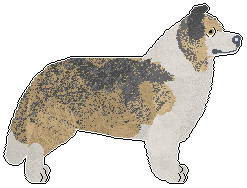 |
| A red sable dog with shading in the maximum pattern (Note: the example does not have enough shading on the legs or face) | A red sable dog with shading in the maximum pattern and an extended mask | A blue sable dog with shading in the maximum pattern and white in the irish spotting pattern |
 |
 |
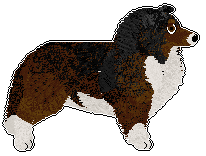 |
| A red sable dog with shading in the maximum pattern, with urajiro markings and a small mask | A red sable dog with shading in the maximum pattern and white in the irish spotting pattern | A red sable dog with shading in the maximum pattern and white in the irish spotting pattern |
 |
 |
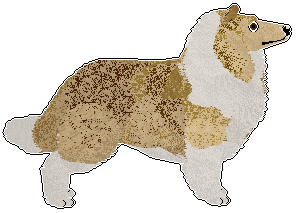 |
| A red sable dog with shading in the maximum pattern and white in the irish spotting pattern | A red sable dog with shading in the maximum pattern and white in the blanket pattern | A red sable dog with shading in the maximum pattern and white in the irish spotting pattern |
Special Markings
Widow's peak
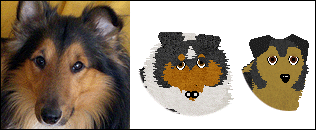
Many sable dogs exhibit a so-called widow's peak. Most sable dogs have tan muzzle and eyebrows, which also constitutes the smallest allowed widow's peak, but paintballs can be used to create a more advanced one. A large widow's peak may cover most of the face.
The image above shows two examples of what a widow's peak can look like, as well as an example of a real life one. If a breed standard states that this marking is preferred in the breed, the dog is preferred to have facial markings similar to one of the examples.
Harness Marking
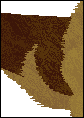
A harness marking is a paintball (or in rare cases, if the file allows it, addball-based) marking that goes behind and sometimes in front of the shoulders, resembling an elongated stripe-type marking, somewhat as if the dog was wearing a harness, hence the name. Harness markings are accepted in all sables, and uses the base colour. The harness marking goes behind the shoulder, and may also be present in front of it.
