
Skye Terrier
Coat
Solid:


Sable: Faded red sable in the clear, minimal, or classic pattern.
Due to the long fur and greying gene, the pattern appears different from in most other breeds.
Allowed base colours are  and the shading is , present as tipping only, not solid colour.
Due to the long coat, the tipping may reach farther down on the sides than in other sable dogs.
Brindle: One of the solid colours with striping, except .
Masking: All colours above must have at minimum of some on the ears. All degrees of masking are also accepted.
White Markings: A small  chest patch is allowed.
Eyes

Nose

Faults
None
Disqualifications
None


Conformation Champion Showcase

Ch. Energizing Long Story
Jaskierek
A260619014
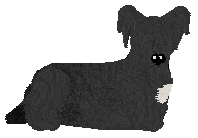
Ch. RCh Energizing TOO LONG, SO FAR
Mandy
A260310101
Notes
The Skye Terrier originates from Scotland, and is one of the oldest Scottish breeds. He was previously known as the Terrier of the Western Isles. He is loyal to his family but he does not trust strangers. One loyal Skye Terrier named Greyfriars Bobby in approximately 1858 sat at his master's grave until he himself died.
The Skye Terrier should appear elongated, low with a long coat. The body is twice as long as it is tall. The head is long and powerful, with slight stop and powerful muzzle. The eyes should be expressive. The ears are erect or hanging, well covered in fur. The neck is long and slightly arched. The body is long and low with straight back and deep, long chest. Short and muscular legs. The tail is carried hanging, or as a continuation of the back when the dog is moving. The coat consists of a short, wooly and thick undercoat, and long, hard and straight topcoat. The coat on the head should further enhance the its lines and the shape of the ears.
Breed Files
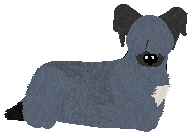
Abnormality
Filename: Skye TerrierOffset: CFF3
Base: Dalmatian
SCP: Dalmatian
Accepted: January 8, 2005
Notes: Various addballs. Ear fringes in second generation dogs differ slightly from first generation dogs. Must be registered as puppies as the eyes are not visible in adults.
