American Hairless Terrier
Coat
Hairless
Solid:


Tan: may have in the traditional or creeping pattern.
Masking: All of the above may be masked (standard mask). The mask can be and matches pigment type - black in black-based dogs, liver in livers etc.
White Markings: Must always have some white (always represented by pale pink in this variety) somewhere on the body, and may be solid white (pink) all over.
Ticking/Roaning: Ticking is allowed.
When surrounded by white (pink), the liplines in this variety may be flesh without fault, regardless of pigment type.
Coated
Solid:
Tan: may have in the traditional or creeping pattern. Points may be brindled.
Sable: Any sable combination in any of the patterns.
Brindle: Allowed brindle combinations are:
with striping.
with striping.
with striping.
Masking: All of the above may be masked (standard mask). The mask can be and matches pigment type - black in black-based dogs, liver in livers etc.
dogs can be masked with any of the mask colours. Masks are not preferred in all non-tan-marked dogs.
White Markings: The american hairless terrier must always have some  somewhere on the body and may be solid all over.
Ticking/Roaning: Ticking is allowed but the white must be clearly visible.
Eyes
 in black-nosed dogz.

 in blue and liver-nosed dogz.
in isabella dogz.
Nose
Black dogz have 
Blue dogz have 

Dark brown dogz have 
Dusty dogz have
Cream to red dogz have can have any of the above.
Tan points, sables, and masked dogz follow the main/shading/masking colour.
Solid hairless dogz may have without fault in all solid colours to represent different skin tones.
Faults
Wrong nose colour.
Wrong eye colour.
Disqualifications
Hairless dog that uses instead of pink for white.
Hairless dog with docked tail.


Conformation Champion Showcase
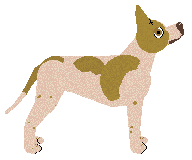
Ch. Lustre The Forgotten Pistolero
Agamemnon
A260428021
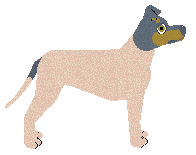
Ch. Lustre City of Owls and Olives
Athens
A260316008
Notes
The first American Hairless Terrier originated from a Rat Terrier named Josephine, who was born in 1972 with an unusual hairless coat mutation. The breeder, Edwin Scott, began to develop a new strain of Rat Terrier from Josephine's descendants. While this strain included no other breed besides the Rat Terrier, the final goal was to have it recognized as a separate breed.
When the Rat Terrier was recognized by the United Kennel Club in 1999, Scott and the other breeders agreed to let their dogs be registered as 'Rat Terrier, hairless variety'.
When the breeds were separated in 2004, the hairless dogs as well as their coated descendants were named 'American Hairless Terrier'. It's important that the coated dogs are used in the breeding program, as well as the occasional Rat Terrier that is still crossed into the breed, to avoid health and other genetic issues, until the breed has a large enough gene pool to not need such crossings.
The American Hairless Terrier is smoothly muscled and active. It has a broad, wedge-shaped head with V-shaped ears. The tail may be docked in the coated dogs, but hairless specimen should always have a natural tail.
The coated variety should have a short, dense and smooth coat, while the hairless should be completely hairless save whiskers, guard hairs on the muzzle, and eyebrows and sometimes short, fine hairs on the body.
Breed Files
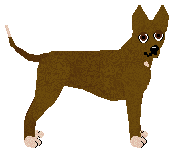
Supernova (Hairless)
Filename: American Hairless TerrierOffset: 0004
Base: Chihuahua
SCP: Chihuahua
Accepted: November 10, 2008
Notes: Addballz ears (three variations) and tail (4 carriage variations). Optional liplines and forehead wrinkles.
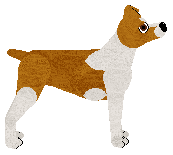
Supernova (Coated)
Filename: American Hairless Terrier (coated)Offset: 0003
Base: Chihuahua
SCP: Chihuahua
Accepted: November 10, 2008
Notes: Addballz ears (three variations) and tail (4 carriage variations, all can be full or docked). Optional liplines.
