Merle
General
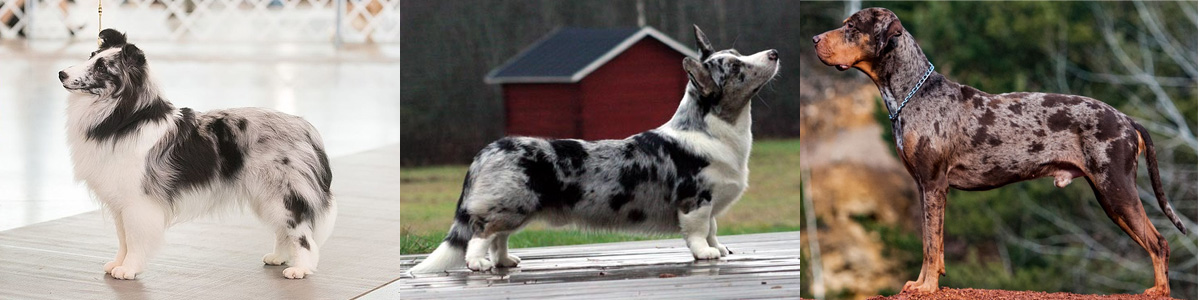
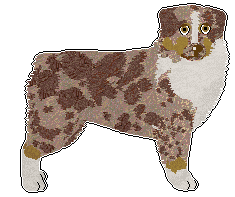
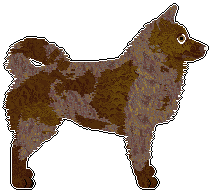
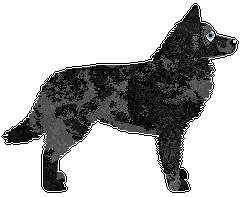
Merle (sometimes known as dapple or leopard) is a dog-specific pattern with complex genetics, where the coat is partially diluted to different degrees. This look can be achieved with furfiles and/or paintballz. The patches can range from very small to very large, and can be mingled or clearly defined, with sleeves, split faces, uneven distribution of colour, etc.
UKC allows a high level of flexibility when it comes to merle dogs - we want hexers to be able to create realistic patterns without being held to too many rules. Whilst we allow broad freedom for hexers, stewards may choose to reject very unrealistic merle patterns on a case-by-case basis.

Merle appears in many forms with a wide range of appearances. In real life, a dog's merle pattern is determined by a the "length" of their merle gene(s). The genetics of merle have been poorly understood until recently, when research discovered that merle is not caused by a single gene but by the interaction of many different "lengths" of merle. These combinations create a wide variety of possible looks, ranging from high contrast, bold patterns to subtle mingled patterns.
UKC has taken much of the following information and descriptions from PKC, but have relaxed and simplified the requirements for many of the patterns. UKC splits merle into only two types - 'strict' and 'relaxed'; the breed standards will specify which type is allowed for that particular breed. Always refer to the individual breed standard for specific/special requirements.
Please note: Throughout this document, the term "merling" refers to the lighter colour in the coat. The darker colour is referred to as the 'base'.
'Strict' merle
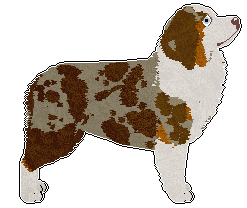
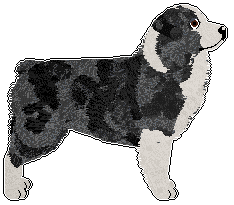
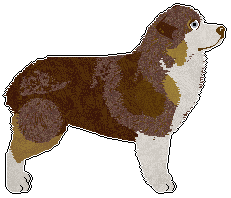
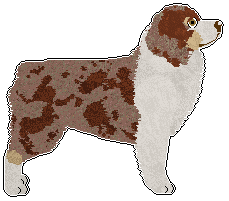
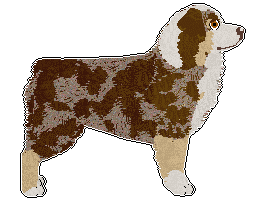
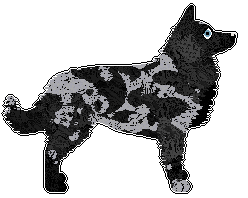
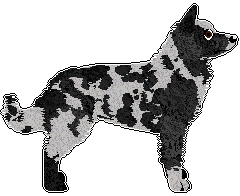
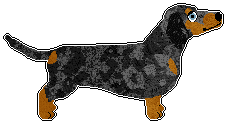
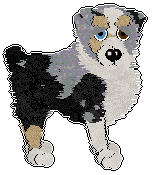
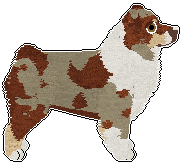
Within UKC, strict merle includes the most common types of merle patterns seen across all breeds that come in merle. The contrast between the base colour and the merling colour(s) should be moderate to high - more information on allowed colours for each pigment is given below. The patches of merling may be small or large, and UKC allows tipping textures to be used to create mingled patches of merling, though these must not dominate the overall pattern of the dog. Neither colour must overly dominate - it is recommended to aim for at least a 60/40 split between colours, with 50/50 being ideal - but we are aware that other coat patterns (such as tan points or white spotting) may cover the merle pattern and potentially skew this split.
 |
 |
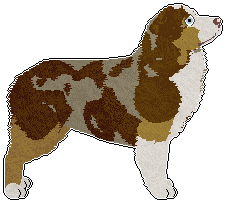 |
| A red merle dog with tan in the standard pattern and white in the irish spotting pattern | A blue merle dog with white in the irish spotting pattern | A red merle dog with tan in the minimal creeping pattern and white in the irish spotting pattern |
 |
 |
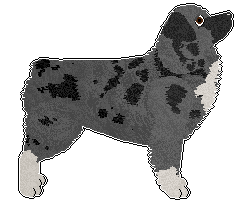 |
| A red merle dog with tan in the minimal creeping pattern and white in the irish spotting pattern | A red merle dog with tan in the standard pattern and white in the irish spotting pattern | A blue merle dog with white in the irish spotting pattern |
 |
 |
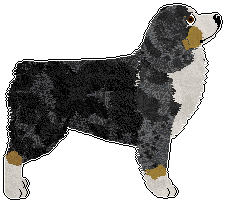 |
| A red merle dog with tan in the standard pattern and white in the irish spotting pattern | A red merle dog with tan in the standard pattern and white in the irish spotting pattern | A blue merle dog with tan in the standard pattern and white in the irish spotting pattern |
 |
 |
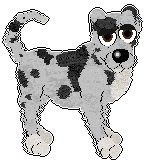 |
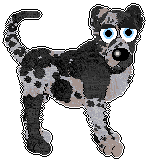
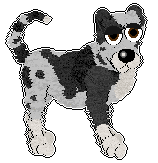
| A blue merle dog (uses a palette) | A blue merle dog with white in the irish spotting pattern | A blue merle dog with white in the irish spotting pattern |
 |
 |
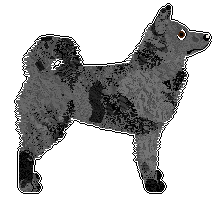 |
| A red merle dog | A blue merle dog. A tipping texture has been used here to create mingled patches | A blue merle dog. A tipping texture has been used here to create mingled patches |
 |
 |
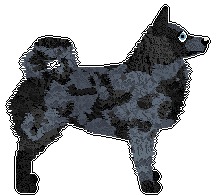 |
| A blue merle dog | A blue merle dog | A blue merle dog |
 |
 |
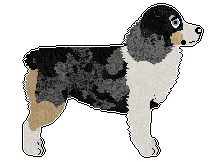 |
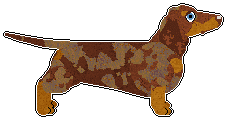
| A red merle dog with tan in the standard pattern | A blue merle dog with tan in the standard pattern | A blue merle dog with tan in the standard pattern and white in the irish spotting pattern |
 |
 |
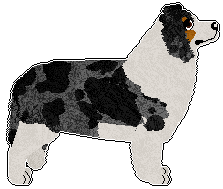 |
| A blue merle dog with tan in the standard pattern and white in the irish spotting pattern (please note that there is tan on this dog's second cheek - it is hidden by a ball roll) | A red merle dog with tan in the standard pattern and white in the irish spotting pattern | A blue merle dog with tan in the standard pattern and white in the irish spotting pattern |
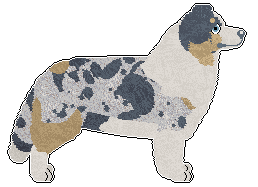 |
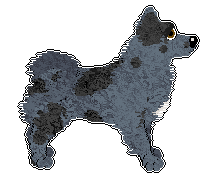 |
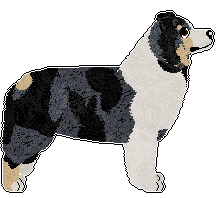 |
| A slate merle dog with tan in the standard pattern and white in the irish spotting pattern | A blue merle dog with white in the trim pattern | A blue merle dog with tan in the standard pattern and white in the irish spotting pattern |
'Relaxed' merle
In breeds that allow relaxed merle, all of the patterns and combinations for strict merle are accepted, with the following additions:
Atypical merles
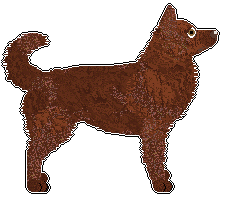
In relaxed merles, there may be a lower contrast between the base colour and the merling colour. Atypical merle may also show undefined patches, where tipping furfiles are used over the entire dog to portray unevenly-sized smaller spots. More defined patches are also allowed, but full sleeves and bold patterns should be avoided. Typically, the colour combination will also be low contrast.
 |
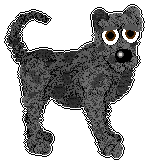 |
| A red merle dog with a low amount of contrast between the base colour and the merling colour (Note: relaxed merle is not allowed in Mudi) | A blue merle dog with a ticking texture used to create undefined patches |
Minimal Harlequin merles
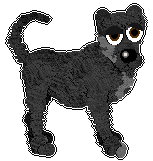
Classic and Bold Harlequin merles are merles with a high contrast between the base colour and the merling, and they fall under the strict merle umbrella. However, Minimal Harlequin merles are different, and feature very restricted merling. In a Minimal Harlequin merle, the overall impression is a dog that appears almost non-merle, with patches of merling restricted to the head/face, front of chest/neck, and/or legs. The dog should not have more than roughly 20% visible merling overall. Dilute spots are not allowed. See below for information on dilute spots.
 |
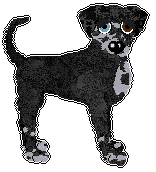 |
| A blue minimal harlequin merle | A blue minimal harlequin merle. Please note that merle is not allowed atall in Dalmatians. |
Dilute spots and 'tweed merle'
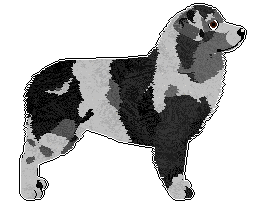
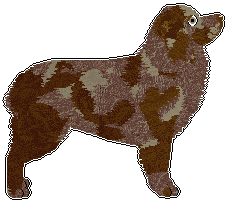
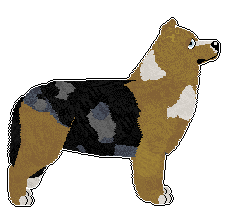
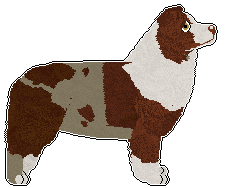
Dilute spots and tweed merle are when a third or fourth colour is introduced into the merling pattern. Dilute spots are typically small and inconspicous, covering up to only 20% of the dog, and the overall impression should be over a two-coloured coat, rather than a three-coloured one. Tweed merles feature patches of a third colour that are often larger and less inconspicous. UKC is not super strict on these patterns - it is up to you whether you want to aim to hex a merle with dilute spots or a tweed merle. However, the following caveats, or differences, between strict merle and relaxed merle do apply:
'Strict' Merle: Dilute spots and tweed merle are allowed using a third colour (i.e, one additional colour to the existing merling colours). The third colour must not be lighter than the primary merling colour, and must be an accepted colour for the colour/pigment of the dog (e.g a blue merle must use a third colour that is also accepted under blue merle).
'Relaxed' Merle: As with strict merle, but a fourth colour (i.e two additional colours to the existing merling colours) is allowed to represent a tweed merle. Once again, neither the third or fourth colour can be lighter than the primary merling colour, and they must be accepted colours for the colour/pigment of the dog (e.g a blue merle must use third and fourth colours that are also accepted under blue merle).
For both strict and relaxed merle, the dilute and tweed spots may be a lighter shade of the base colour or a darker shade of the merling colour.
All of the following examples include only third merling colour, and are therefore all acceptable in breeds that require strict merle.
 |
 |
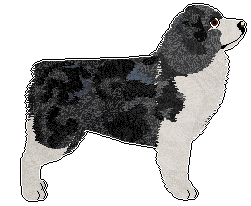 |
| A blue merle with dilute spots | A red merle with dilute spots | A blue merle with dilute spots and white in the irish spotting pattern |
 |
 |
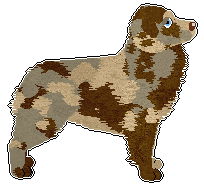 |
| A blue tweed merle with tan in the saddle pattern and white in the irish spotting pattern | A red tweed merle with white in the irish spotting pattern | A red tweed merle |
Allowed Colours and Patterns
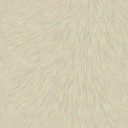
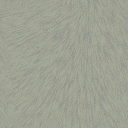
Below are the allowed merle combinations. The first colour is the base colour, which determines the pigment type of the dog. Dilute spots in all merle types may use colours listed as merling colours or relaxed merling colours. If using palettes, these swatches show rough ballparks for accepted colours - remember it is up to the stewards' discretion as to whether they think the colours you use are accurate enough representations of the swatches below. Some of these swatches represent textures - a further table has been included below to illustrate what textures they represent.
Blue Merle (black pigment)
Base: 
Merling: 


Relaxed merles may also have 


Red Merle (liver pigment)
Base:  or
or
Merling: 


Relaxed merles may also have if base is
Slate Merle (blue pigment)
Base: or or
Merling: . if the base is
Relaxed merles may also have if base is , and if base is
Isabella Merle (isabella pigment)
Base: or
Merling: . if base is
Palettes
When using palettes, relaxed merles may use a base/merling colour that represents the same swatch as the other colour being used providing the two colours are visibly distinct. E.g. A red merle could have a base and a liver colour from a palette as the merling colour.
Swatch to Texture Chart
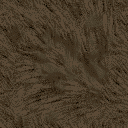
These are examples for each swatch - there are likely more textures out there that are fair representations for each swatch. This table applies specifically to merles - the same textures may not necessarily represent the same swatches in other patterns.
Some textures give the apperance of an atypical merle. If you are hexing a breed that doesn't allow relaxed merle, please keep this in mind.
| Swatch | Shorthair / all fur types | Longhair | Wirehair |
|---|---|---|---|
|
Ivory / cream / pale isabella |


|
|


|
|
Lilac |

|
|

|
|
Silver |


|


|


|
|
Cinnamon |

|


|


|
|
Brown |


|


|


|
|
Seal |

|
|

|
|
Dark Blue |

|

|

|
Merle Combined with Other Patterns
Any pattern with black-based pigment can be affected by the merle gene(s). True red dogz cannot be merle, and any true red areas on a dog cannot be merle, but any black-based areas or hairs can be affected.
Masking
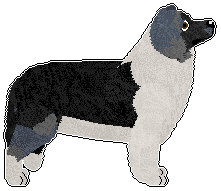
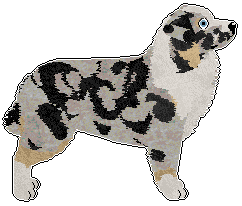
If the dog has a mask, the mask should also be merled. It is normal and acceptable for a merled mask to blend in with the rest of the coat's merle pattern on a non-red dog. Please refer to the masking doc for mask patterns. Some examples of merle masking are shown below:
 |
 |
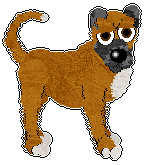 |
| A blue tweed merle dog with a standard mask (merled) and white in the irish spotting pattern | A blue merle dog with a standard mask (merled), tan in the standard pattern and white in the irish spotting pattern | A solid red dog with a standard mask (merled) and white in the trim pattern |
Tan Points
Merle is often combined with tan points - further examples can be seen above. Tan points appear above the merle pattern, and their tan/cream pigment is not affected by the merle gene, and so should follow the tan points doc.
Sable/Grizzle Merle
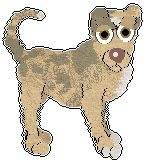
Sable and grizzle may both have merle in addition to their base pattern. Only shaded/tipped areas are affected by the merle gene; the red/tan/cream areas are not. This results in a dog with uneven shading/tipping, which can be achieved in a couple of different ways:
- Option A: Instead of having uniform, symmetrical shading/tipping, the shading is removed on random areas, resulting in a patchy appearance. Additionally, one may use a darker or lighter shade of the base colour to represent faint merling. The above dog is an example of this option, Option A.
- Option B: Merling is represented by keeping the shading/tipping symmetrical, but replacing parts of the shading/tipping colour with an allowed merling colour for that pigment type. For example, a dog with shading can show patches of shading to represent merling.
Brindle Merle
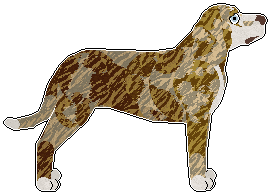 |
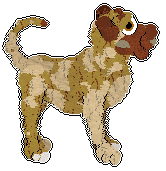 |
| A red brindle merle with white in the irish spotting pattern | A red brindle merle with white in the trim pattern and a standard mask - the mask is also merled |
Brindle merle is a combination of the brindle and merle patterns, which results in a dog that looks like the above. The striping will be a mix of the regular brindle striping colour and a merling colour accepted for that pigment type - for example, in a black brindle merle, a dog would have a mix of black and either blue or grey striping, over a red-based base colour, such as red, tan or cream.
The base colour may remain the same colour under both of the striping colours, or, underneath the lighter striping colour, the base may be a lighter shade or lighter related colour of said base colour. The dogs above are examples of the base colour being a lighter related colour on the merling/the lighter striped areas.
The stripes must always appear darker than the base colour no matter what colours are used. Please refer to individual breed standards to see if brindle merle is an accepted pattern in that breed.
