
Hairless
General
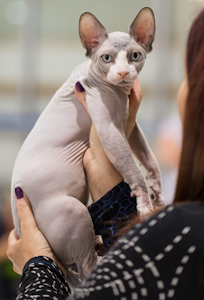
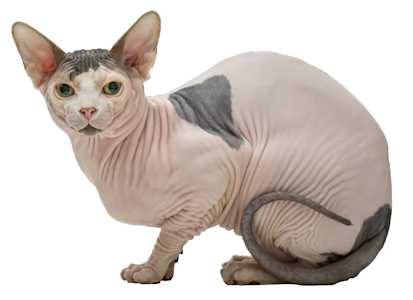
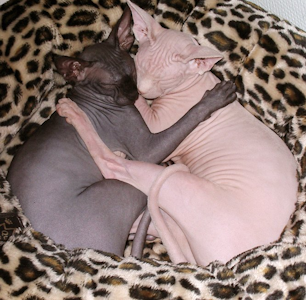
Hairlessness is a natural mutation that has occurred several times in catz, and can be caused by a few different genes. While it may look unusual or even disturbing, hairless cats are not inherently any less healthy than coated cats. However, hairless cats are more vulnerable to sun exposure, cold, bruising, and scratches than coated cats - making them best suited for a strictly indoors lifestyle with lots of cute sweaters! As there is no coat, the various colours and patterns known in cats often appear significantly different in hairless breeds. This Doc is intended to provide a guide to show how to represent these patterns.
A quick primer on skin textures
Hairless catz use specific skin textures to replace white. Fully Hairless and Velour catz may use one of these textures to replace white all over the cat, or they may use one of these textures to replace the white on the hairless areas, with regular white  still being used on the furred areas. Brush catz must always have regular white on the furred areas, with one of the following skin textures replacing the white on the hairless areas. Information on the furred areas for each hairless variety can be found further below.
The three hairless coat varieties may use many of the same textures, with Fully Hairless also being permitted to use some additional, very pink-leaning textures. Additional darker skin textures can also be used in catz with dark pigments. The table below illustrates what skin textures are allowed for each variety and what pigments they are allowed to be used for. All of the textures in the first column may be used on catz of any pigment for catz of the listed hairless variety.
| Hairless Variety | Accepted skin textures (all pigments) | Accepted skin textures (black, blue, lilac and fawn pigments) | Accepted skin textures (black and blue pigments) | Accepted skin textures (black pigment only) |
|---|---|---|---|---|
| Fully Hairless |


|


|


|


|
| Velour & Brush |
|
|
|
|
Coat Types
Throughout this doc:
 is used to depict the skin textures from the Fully Hairless row in the table above - these are only accepted in the Fully Hairless variety.
 is used to depict the skin textures from the Velour & Brush row in the table above.
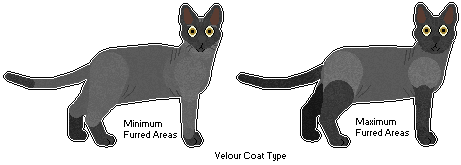
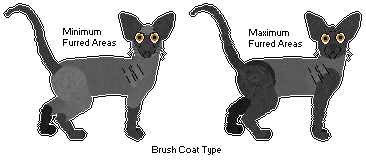
The terms 'furred areas' and 'fur-pointed areas' are also used interchangeably - these terms are used to refer to the parts of the cat that retains hair, dependent on and according to the hairless coat variety of the cat (detailed below).
There are several types of hairlessness known in catz, described below:
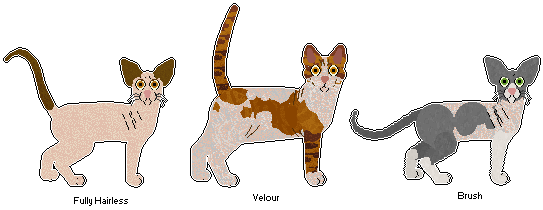
Fully Hairless
Breeds that come in the Fully Hairless variety: Peterbald, Don Sphynx, Sphynx
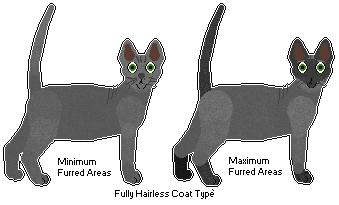
A cat that appears hairless, this coat type varies from truly hairless with a sticky and silk-like feel to the skin to a suede-like down often compared to a chamois. Short, fine hair may be present at maximum on the feet, ears, tail, and face (jowls, nose, cheeks, chin, and around the eyes). There is no minimum, and hair may appear in any amount between the maximum and fully hairless, with hair remaining on the edges of the cat longest. Symmetry is not required, and catz with furred front paws may have bald back paws, etc. Fuzz is not permitted in this coat type.
Solid/Self in Fully Hairless Catz
Solid hairless cats, no matter their coat type, are often much paler than ordinary coated cats. This is represented in Petz using multiple shades or colours, as described below. The body areas and furred areas for the Fully Hairless coat variety are defined above, and the colours should be placed according to them.
Note: It is not required for the hair to be a different colour than the body, provided the same colour is listed as both a body and hair colour. These solid cats may use lighter and darker shades instead of different colours, e.g. 21 and 29.
Black: 
 body with
  furred areas
Chocolate: 
 body with
  furred areas
Cinnamon: 
 body with
  furred areas
Blue: 
 body with
  furred areas
Lilac: body with furred areas
Fawn: body with furred areas
Red: body with  furred areas
Cream: body with furred areas
White: body with furred areas
Velour
Breeds that come in the Velour variety: Peterbald, Don Sphynx
Velour (sometimes called flocked) is a nearly-hairless coat type where the cat has a fine, velvety coat no more than 5mm in length. They appear hairless until touched, where the distinct resistance of hair is felt. They have a denser coat on the legs, tail, and head, although this may not be visible at a distance. Fuzz may or may not be present in this coat type on the furred points.
Brush
Breeds that come in the Brush variety: Peterbald, Minskin
A sparse, wiry semi-hairless coat where hair is present on the whole body to varying degrees, and the skin can be seen through the coat. The furred areas have dense, fine hair compared to much sparser body hair. These furred areas include, at minimum, the face (cheeks, jowls, muzzle, snout), ears, legs, and tail, and at maximum may include the whole head, shoulders, hips, and butt. The neck, chest, and belly are sparsely-coated. Fuzz is required in this coat type on the furred points.
Solid/Self in Velour & Brush Catz
Solid hairless cats, no matter their coat type, are often much paler than ordinary coated cats. This is represented in Petz using multiple shades or colours, as described below. The body areas and furred areas for the Velour and Brush coat varieties are defined above, and the colours should be placed according to them.
Note: It is not required for the hair to be a different colour than the body, provided the same colour is listed as both a body and hair colour. These solid cats may use lighter and darker shades instead of different colours, e.g. 21 and 29.
Black: body with furred areas
Chocolate: body with furred areas
Cinnamon: body with furred areas
Blue: body with furred areas
Lilac: body with furred areas
Fawn: body with furred areas
Red: body with furred areas
Cream: body with furred areas
White: body with furred areas
Colours & Patterns
Due to the hairlessness, many colours and patterns look different in hairless catz than they do in fully coated catz. The following sections break down the differences and changes by pattern.
Tortoiseshell
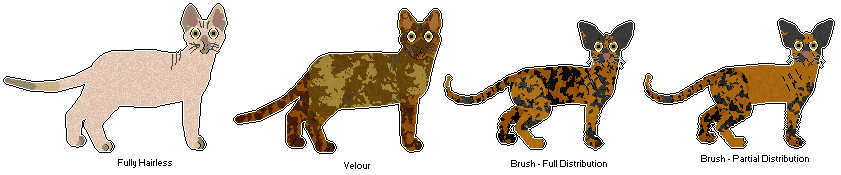
Torties are represented by combining allowed solid colours in the same way as outlined on the Tortoiseshell doc. The furred areas follow the allowed tortie colours from the tortie doc. For the hairless areas, use a black-based colour and a red-based colour from the furred area's matching colour in the combinations above.
It is not required for hairless areas to be visibly tortie marked, provided there is tortie on the furred areas. In this case, use the red-based colour as a solid colour for all the hairless area.
Tabby/Torbie
Tabby is a very subtle pattern in hairless cats, and varies in its appearance depending on the coat type, with stripes almost absent in Fully Hairless catz and a full pattern visible in Brush catz. Allowed tabby/torbie colour combinations are the same as in coated catz, and tabby patterns and striping directions follow the rules laid out on the Tabby doc.
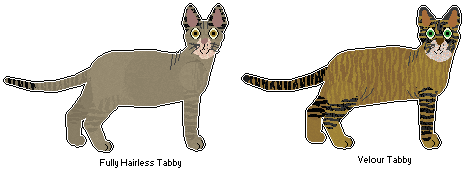
In all three coat types, the regular tabby colour combination is used on the furred areas (as outlined in the Coat Type section).
The amount of striping visible on the body varies by coat type:
Fully Hairless
Hairless areas are either unmarked base colour, a transparent tabby version of the base colour, or unmarked on the torso and transparent tabby on the whole legs, tail, head, and front of chest.
Light markings that use must use on hairless areas. Silver and golden tabbies are not permitted.
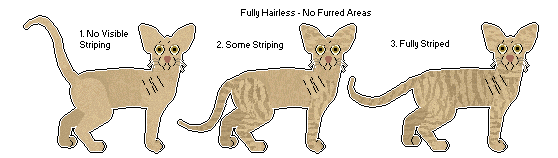
Velour
Hairless areas are a transparent tabby version of the base colour.
Light markings using must use on hairless areas. Silver and golden tabbies are not permitted.
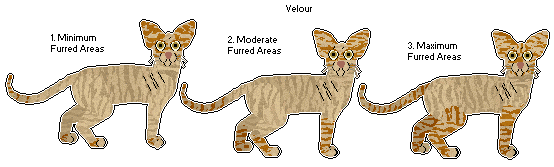
Brush
Hairless areas may be a transparent tabby version of the base colour, or the tabby pattern appears fully coated all over.
Light markings using must use on hairless areas. Silver and golden tabbies are possible and are accepted if the breed standards accept them.
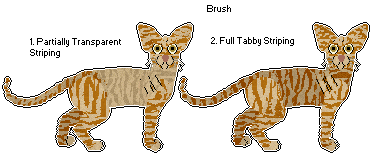
Colourpoint, Mink, & Sepia (Burmese)
As pointed patterns are affected by temperature, hairless catz can be much darker than fully-coated catz. For point pattern locations and allowed colour combinations, refer to the Burmese, Mink, and Colourpoint docs. Additional notes for each coat type are described below.
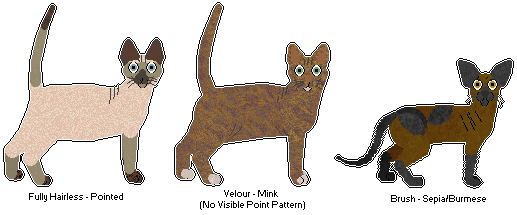
For pointed cats using seal ( ) on the furred points, the following hairless colours may be used:
Fully Hairless: body with furred areas
Velour/Brush: body with furred areas
Fully Hairless
For points, the point colour from the relevant doc should be used on furred areas and a hairless colour on the hairless areas.
For the body, the same colour is used whether the area is furred or not. It can either be a body colour from the relevant doc or a hairless colour for the corresponding colour (e.g. a blue mink may use a blue mink body colour or a blue hairless colour). The body colour must not be darker than the hairless point colour, if one is present.
For any combination using as a body colour or with white markings, must be used on the on hairless areas.
A visible point pattern is required in Colourpoints. In Mink and Burmese catz, a visble point pattern is optional. If it is not present, the cat should use an allowed point colour all over the body, with a corresponding hairless colour on the hairless areas.
Tabby points cannot have body striping.
Velour
For points, the point colour from the relevant doc should be used on furred areas and hairless colour on the hairless areas.
For the body, the same colour is used whether the area is furred or not. It can either be a body colour from the relevant doc or a hairless colour for the corresponding colour (e.g. a blue mink may use a blue mink body colour or a blue hairless colour). The body colour must not be darker than the hairless point colour, if one is present.
For any combination using as a body colour or with white markings, must be used on the on hairless areas.
A visible point pattern is required in Colourpoints. In Mink and Burmese catz, a visble point pattern is optional. If it is not present, the cat should use an allowed point colour all over the body. A cat with no point pattern may be entirely the point colour, including hairless areas.
Tabby points may have transparent tabby body striping.
Brush
For points, the point colour from the relevant doc should be used on furred areas and a hairless colour on the hairless areas.
For the body, any furred areas use a body colour from the relevant doc. For the hairless areas, it may be the same body colour, a lighter shade, or a hairless colour for the corresponding colour (e.g. a blue mink may use a blue mink body colour or a blue hairless colour). The body colour must not be darker than the hairless point colour, if one is present.
For any combination using as a body colour or with white markings, must be used on the on hairless areas.
A visible point pattern is required in Colourpoints. In Mink and Burmese catz, a visble point pattern is optional. If it is not present, the cat should use an allowed point colour all over the body. A cat with no point pattern may be entirely the point colour, including hairless areas.
Any combination using tabby follows the same rules as an ordinary Brush tabby.
White Spotting
White spotting in hairless catz follows the same distribution rules as other breeds, but white is replaced with (Fully Hairless only) or on the truly hairless areas, and may remain on the furred areas. (Fully Hairless only) or may replace all over the cat in Fully Hairless and Velour catz; Brush catz must still use on the furred areas.
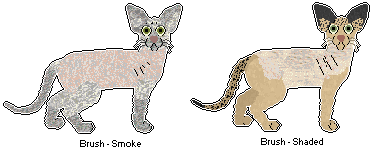
Inhibited Patterns (Smoke, Shaded & Chinchilla)
Smoke, shaded, and chinchilla are patterns that rely on the hair being a specific length. In hairless and near-hairless catz, the hair is often not long enough for these patterns to be visible. In Fully Hairless and Velour catz, these patterns are not allowed as any catz who are genetically this pattern would be indistinguishable from solid white.
Brush catz may be smoke, shaded, and chinchilla - consult the smoke/shaded/chinchilla doc for information on these patterns. Smoke is only visible on furred areas, with the hairless areas being . Very light smoke furfiles are the only ones permitted. Shaded and chinchilla catz would be (silver) or (golden) on the hairless areas, with very light tipping in any ordinary colour combo permitted on the furred areas.
Examples
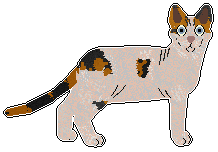
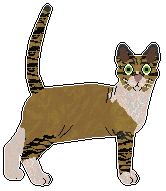
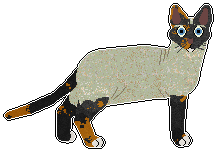
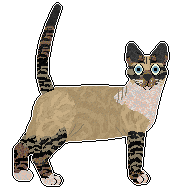
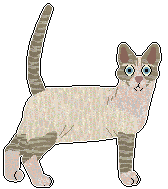
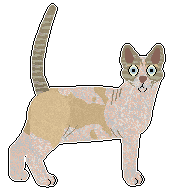
Below is a gallery of hairless coated catz in various different patterns. Many more combinations than these are acceptable, this is just to provide some visual guidance to the text above.
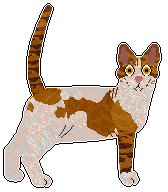 |
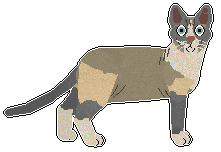 |
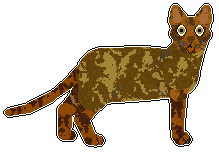 |
| A hairless (velour) red tabby with white in the bicolour pattern | A hairless (velour) blue point with body shading and white in the tuxedo pattern | A hairless (velour) chocolate tortie |
 |
 |
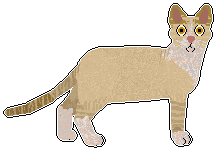 |
| A hairless (velour) tortie with white in the harlequin pattern | A hairless (velour) black tabby with white in the tuxedo pattern | A hairless (fully hairless) cream tabby with white in the tuxedo pattern |
 |
 |
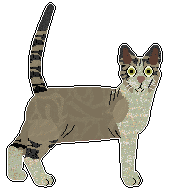 |
| A hairless (velour) tortie point with white in the trim pattern | A hairless (velour) black tabby point with gradually fading points and white in the tuxedo pattern | A hairless (velour) black tabby with white in the tuxedo pattern |
 |
 |
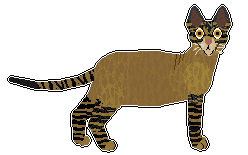 |
| A hairless (velour) fawn or lilac tabby point with white in the tuxedo pattern | A hairless (fully hairless) fawn tabby point with white in the bicolour pattern | A hairless (velour type) black tabby with light markings. Note that this cat is not a-reg, as Sphynx are only permitted in the 'fully hairless' type of hairless catz |
