Turkish Angora
Coat
Solid:


Tabby: Brown (black), blue, red, and cream tabby in any of the patterns. These in silver and golden tabby are also accepted.
Tortoishell: Black and blue tortie are accepted.
Torbie: Torbie versions of the above listed Tabby/Tortie combinations are accepted.
Smoke/Shaded/Chinchilla: Black, blue, red, cream, black tortie, and blue tortie in any of the patterns, silver or gold base.
White Patterns: Any of the above colours may come with or without in any amount.
Eyes


Solid whites and catz with at least 75% white spotting may have one or two 
Nose
Faults
Wrong accepted nose colour.
Disqualifications
None


Conformation Champion Showcase
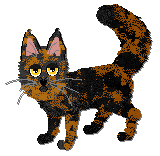
Ch. Frogbowl Spring Awakening
Pinar
A260508004
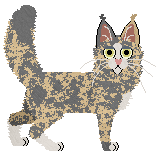
Ch. MGCh Fauvelle's Touch of Whimsy
Whimsy
A260303100
Notes
An ancient breed, the Angora is often said to be the first longhaired cat in Europe, a statement that while dramatic, ignores the fact that native northern and eastern breeds certainly predate the arrival of the Angora to Europe in 1520. However it holds a kernel of truth: the silky, elegant coat of the Angora was unlike any other coat seen in Europe at that time. They were very fashionable until the Persian arrived in the late nineteenth century, after which the history of the Angora clouds. Certainly they fell from favour, and were interbred with the double-coated Persian cats. However Turkey realized that preserving their national cat was important, and by the 1950s there was a well-established conservation program operating out of the Ankara Zoo in Ankara, Turkey. The zoo preferred the flashy all-white cats, with blue or odd eyes. Americans living in the city managed to obtain the first imports to America in 1954. They were accepted for registration in 1972, in white only; the colours were not added until 1978. Today, all Turkish Angoras must be able to trace their ancestry back to cats imported directly from Turkey.
Type & Judging Remarks
The Turkish Angora is a balanced, graceful cat with a fine silky coat in contrast to the firm, long muscular body beneath it. The head is small, but in balance with the length of the body. The ears are tall, wide at the base and set closely together, high on the head, vertical and erect. Although the traditional colours of the breed are solid white and solid black, breeders have worked to further develop other colours while maintaining type. Today, little colour preference remains in the breed, although some judges certainly lean towards the whites.
Breed Files
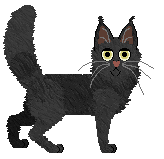
Aniseed
Filename: Anisd Turkish AngoraOffset: 4104
Base: Russian Blue
SCP: Russian Blue
Accepted: February 20, 2026
Notes: 2 size variations (larger size intended to represent toms), 9 colors with or without white, and a few ear tuft variations! Does not breed especially well. Comes with a few LWH furfiles for tabby variations. Available as Non-OW and Russian Blue OW.
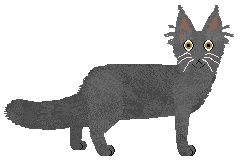
Lime Green Flamingos
Filename: STurkOffset: 3750
Base: Calico
SCP: Tabby
Accepted: November 17, 2019
Notes: 4 tail variations, optional ear fluff, 3 ruff/fur lengths, addball whiskers. Doesn't breed true- bred pets must be .pet hexed.
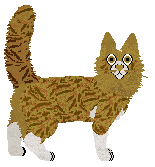
Zodiac
Filename: Turkish AngoraOffset: EFF
Base: Tabby
SCP: Tabby
Accepted: June 24, 2006
Notes: Includes two fur lengths - in 2nd gens, the catz may have either fur length's texture without fault. When mixing coat types, you may end up with a cat with only half a ruff, which is not registerable.
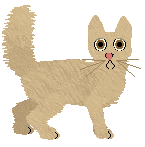
Paranoia V2 (Updated)
Filename: TurAngPOffset: 99AB
Base: Persian
SCP: Persian
Accepted: January 5, 2006
Notes: Updated outlines, jowls and feet.
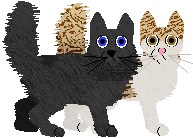
Paranoia V2
Filename: TurAngPOffset: 99AB
Base: Persian
SCP: Persian
Accepted: December 12, 2005
Notes: Version 2 - File has two coat lengths. The addballz ruff grows in with age.
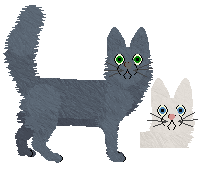
VPZ
Filename: Turkish AngoraOffset: 0905
Base: Tabby
SCP: Tabby
Accepted: February 11, 2005
Notes: A couple of body length variations, and ruff variations.
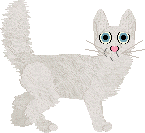
Paranoia V1
Filename: TurAngPOffset: 99AB
Base: Persian
SCP: Persian
Accepted: January 5, 2006
Notes: Version 1.
