
Scottish Fold
Coat
Solid:


Tabby: Any of the tabby combinations in any of the patterns, including golden tabby.
Tortoishell: Any of the tortoiseshell combinations.
Torbie: Any of the torbie combinations of the allowed tabby combinations.
Smoke/Shaded/Chinchilla: Any of the above listed colours in any of the patterns on a silver or gold base.
Colourpoint/Himalayan: Any of the colourpoint combinations.
White Patterns: Any of the above colours may come with or without in any amount.
The Ubisoft file may have a white tailtip with slight fault.
Comes in longhair and shorthair varieties.
Eyes


Colourpoint catz have 

Catz with at least 50% white spotting may have one or two
Solid white catz may have any of the above.
Nose
Faults
White tailtip is a slight fault in Ubisoft Scottish Folds (DQ in other files).
Disqualifications
White tailtip in non-Ubisoft files.


Conformation Champion Showcase
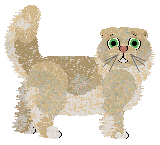
Ch. Taremu Bleeding Cream
Joy
A260227005
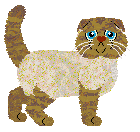
Ch. SGCh Frogbowl Looks That Kill
Motley
A260824048
Notes
The Scottish Fold occurred as a spontaneous mutation in farm cats discovered near Coupar Angus in Tayside, Scotland. Developed through crosses to the British and American Shorthairs as well as to further local Scottish cats, all true Scottish Folds trace their ancestry back to Susie, the first folded-ear cat discovered by the breed founders, William and Mary Ross. Today’s Fold is a hardy cat, with a sweet disposition that matches their expression. They have tiny voices that they rarely use, but can be opinionated when they need to be. They enjoy human companionship and easily adapt to new situations.
The Scottish Fold is one of a very few number of breeds who have a health requirement on their show standard, asking for flexible ear cartilage and a flexible tail. While the ears may seem obvious, the flexible tail requirement is there to ensure that the cat does not have osteochrondrodysplasia (OCD), a potentially lethal disease where cartilage stiffens and fuses together. Because of this, all show Folds are bred from one folded-ear parent and one straight-eared parent, and the Scottish Fold is not accepted in several European organizations including Britain’s GCCF due to health concerns. The straight-eared cats, known as Scottish Straights, are only eligible for show in some organizations, but they are absolutely essential to the continuation of the breed.
Type & Judging Remarks
The ears should be folded tight to the head, giving them what some judges call the “baseball head”. They have a very sweet expression, which the ears emphasize. Despite their parentage, they are not an excessively cobby cat and are of a medium type with a well-rounded appearance. Flexibility of tail desirable.
Breed Files
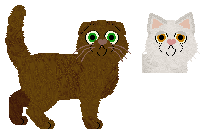
Aniseed
Filename: Anisd ScottishOffset: 1025
Base: Chinchilla Persian
SCP: Chinchilla Persian
Accepted: January 10, 2020
Notes: Addball straight/fold ear variations (to be registered as Scottish Fold/Straight depending on type), two eye size options, .pet hexing bred petz is recommended.
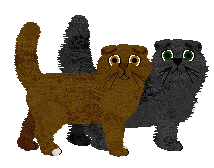
Paranoia
Filename: ScottishFoldPOffset: D78C
Base: Persian
SCP: Persian
Accepted: June 11, 2006
Notes: Includes longhair and shorthair variations.
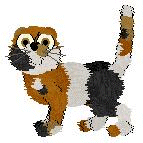
The Duck Retrievers
Filename: FoldOffset: B713
Base: Calico
SCP: Calico
Accepted: January 4, 2006
Notes: Shorthaired.
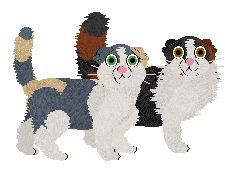
Quasar
Filename: Quasar Scottish foldOffset: A99C
Base: Tabby
SCP: Tabby
Accepted: December 30, 2005
Notes: Includes both longhair and shorthair varieties. Different coat types can be crossed but it is not recommended.
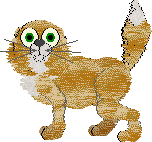
Ubisoft
Filename: Scottish FoldOffset: FF03
Base: -
SCP: -
Accepted: September 1, 1998
Notes: Longhair variety. The original unhexed PFMagic file, as released for Petz 5.
