Leopard
General
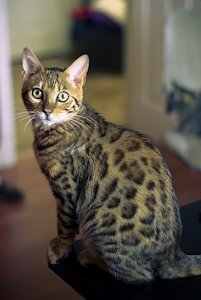
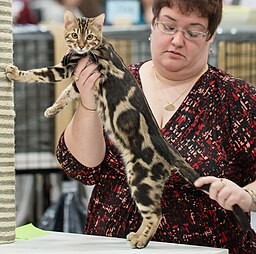
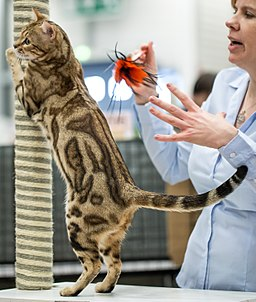
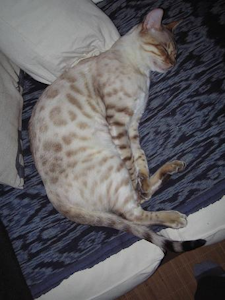
Leopard is a unique form of tabby pattern that occurs in cats with wild ancestry, i.e. they are descended from the hybridization of an ordinary domestic cat and one or more wild cat species. Because of this, these tabbies differ from the four regular tabby patterns that occur in purely domestic felines. They feature unique striping patterns, different shades and tones (often more red or golden), and even a "melanistic" morph.
For all leopard tabbies, the same guidelines apply as for regular tabby when it comes to the barring, optional markings, no pattern, muzzle and ear sections. The major differences are in the body pattern, colour combinations, light markings, and snout colour.
Light Markings
As in regular tabbies, light markings are optional. However, they are considered desirable in leopards. The same guidelines apply to leopards as to regular tabbies, with the following additions/modifications:
- They are not required to be present on the throat/front of chest
- They may be present on the toes and fingers
- There may be a ring of light marking colour used underneath the striping before/below a dark, stripe-coloured tail tip, either as paintballz or the next tail ball
- When present on the throat/chest and undersides, these areas may show the leopard markings present over the light markings
For all base colours, the light markings can be either a lighter shade of the base colour, a related colour,  , or
, or  . Base colours other than can use
  as light markings. If the base colour is

 , the light markings can be
  .
.
Snout
Leopard tabbies may follow existing regular tabby rules for snouts (solid base colour, solid base colour with darken furfile, or striped/ticked), or they may have a solid, stripe-coloured snout.
Patterns
Leopards come in two main patterns, Spotted and Marbled, although there are many variations within each type. Regardless of type, all patterns use the same barring/horizontal striping textures on the face, legs, and tail as regular tabbies. Where appropriate, regular tabby body furfiles may also be used.
The following tables describe the various leopard patterns. A few texture examples are included for each (where they exist) - more leopard tabby textures can be found on the Leopard page in the Texture Library
Spotted Patterns
| Pattern Name | Texture Examples | Description |
|---|---|---|
| Single Spotted |


|
Solid spots of colour, resembling traditional spotted tabby. The spots may be rounded as for regular spotted tabby or form “arrowhead” shapes. Regular spotted tabby textures may be used to depict this pattern in leopard tabbies. |
| Rosettes |


|
The classic “leopard spot” Bengal pattern. The spots are broken into groups that may loosely resemble pawprints, arrowheads, donuts etc. They may be “empty” or have a shaded interior, using a permitted cluster colour with the stripe colour edged around it. |
| Inverted rosettes | Currently no textures | Similar to regular rosettes, but with colours reversed. The centre of the rosette is the stripe colour, and the edge is a permitted cluster colour. |
Marbled Patterns
| Pattern Name | Texture Examples | Description |
|---|---|---|
| Classic |


|
As for a classic tabby, classic marble leopard consists of solid stripe-coloured swirls and blotches. Defined bull's-eye markings on the body are not desired in leopard tabbies. Regular classic tabby textures may be used to depict this pattern in leopard tabbies. |
| Tri/Quad-colour |


|
One of the most striking leopard patterns, tri-colour marble has swirled and/or blotched markings that show one or two cluster colours with the stripe colour as edging. Note that existing textures only depict tri-colour — there are currently no textures for quad-colour. |
| Horizontal |


|
This pattern consists of elongated stripes giving a horizontal appearance, using a solid stripe colour or clusters with the striping colour as edging. |
| Chaos |


|
More of a lack of pattern than a pattern in itself — chaos consists of a variety of swirls and splashes of different sizes and shapes. The dark patterning may be solid or may use a cluster colour with the stripe colour as edging. |
| Reduced Pattern |

|
A form of marble where the pattern is very minimal, showing much of the background colour. Remaining pattern resembles uneven stripes or elongated blotches and is solid stripe-coloured. |
| Sheeted Pattern |


|
An inverted form of reduced pattern — sheeted marble is largely stripe-coloured with very little background showing. The swirls form large, heavy, solid-coloured blotches. Heavy classic tabby textures may be used to create this effect in Petz. |
Colour Combinations
Below are allowed leopard colour combinations. Each of the combinations have three parts:
- First is the base colour.
- Second is the stripe colour, which is used on all tabby markings except clusters. Note that despite the name, it is also used on spotted patterns.
- Third is the cluster colour, which is used on body patterns that use more than one colour.
- Most patterns allow only one cluster colour to be used on the same cat, but quad-coloured marbles allow two.
- The cluster colour must always be darker than the base colour.
- The cluster colour must be either a darker shade or darker related colour of the base colour, or one of the additional cluster colours listed below.
Regular Colours
Dense Colours
Black leopard
with  striping, may have

 clusters (if clusters are present)
 with striping, may have clusters (if clusters are present)
If the base colour is not , the body striping may be (striping must remain on the head, legs and tail)
Chocolate leopard
with striping, may have clusters (if clusters are present)
Cinnamon leopard
with striping, may have clusters (if clusters are present)
If the striping is not , then the clusters may be (if clusters are present)
Dilute Colours
Blue leopard
with 
 striping
with striping
Lilac leopard
with  striping, may have clusters (if clusters are present)
 with striping
with striping
Fawn leopard
with striping, may have clusters (if clusters are present)
with
Silver Colours
Black silver leopard
with striping, may have clusters (if clusters are present)
Chocolate silver leopard
with striping, may have clusters (if clusters are present)
Cinnamon silver leopard
with striping, may have clusters (if clusters are present)
Blue silver leopard
with striping, may have clusters (if clusters are present)
Lilac silver leopard
with striping, may have clusters (if clusters are present)
Fawn silver leopard
with striping, may have clusters (if clusters are present)
Snow Leopard
Colourpoint leopard is often referred to as snow leopard. Unlike colourpoints combined with most other patterns, there is often little difference between the body and the points, so no visible point pattern is required.
Visible point pattern:
Snow leopards can have a visible point pattern. This is done using or on the body and one of the above Leopard combinations on the points (see the Colourpoint doc for information on the point pattern). The body may show faint patterning using a transparent tabby furfile. For silver snow leopards, the body colour must be .
No visible point pattern:
Snow leopards without visible point patterns must use one of the following combinations. For combinations that allow more than one striping colour, slight body-to-point contrast can be created by using a lighter allowed striping colour on the body and a darker allowed striping colour for stripes on the points.
Black (seal) snow leopard
with striping, may have clusters (if clusters are present)
with striping, may have clusters (if clusters are present)
Chocolate snow leopard
with striping, may have clusters (if clusters are present)
with striping, may have clusters (if clusters are present)
Cinnamon snow leopard
with striping, may have clusters (if clusters are present)
Blue snow leopard
with striping, may have clusters (if clusters are present)
Lilac snow leopard
with striping, may have clusters (if clusters are present)
Fawn snow leopard
with striping, may have clusters (if clusters are present)
Silver snow leopard
Black (seal) silver snow leopard
with striping, may have clusters (if clusters are present)
Chocolate silver snow leopard
with striping, may have clusters (if clusters are present)
Cinnamon silver snow leopard
with striping, may have clusters (if clusters are present)
Blue silver snow leopard
with striping, may have clusters (if clusters are present)
Lilac silver snow leopard
with striping, may have clusters (if clusters are present)
Fawn silver snow leopard
with striping, may have clusters (if clusters are present)
Charcoal
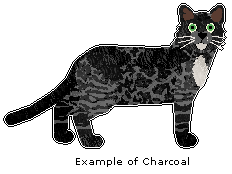
This is a pattern unique to cat breeds with Asian Leopard Cat ancestry. It is the result of crossing solid domestic cats to leopard tabby hybrids. It results in a form of leopard that is darker and heavier than regular leopard, and visually has a similar effect to Heavy Tabby in non-hybrid cats and the "king cheetah" pattern seen in wild cheetahs, and in some cases even resembles melanistic leopards and jaguars (so-called "panthers"). It may be applied to any leopard colour or pattern. Snows, minks, and sepias must reflect the appropriate base or stripe colour for point and body areas; if the body is solid, the dorsal stripe must be solid as well.
Charcoal is only accepted in a breed if it is specifically listed in the breed standard.
PatternCharcoal can occur with any leopard pattern, although it looks different. Consequently, heavy tabby textures may be used instead of or in combination with regular leopard textures. Charcoal leopard can come in the following texture combinations:
- Regular striping on the body and regular striping on legs/face/tail
- Regular striping on the body and heavy striping on legs/face/tail
- Regular striping on the body, heavy striping on the dorsal stripe, and heavy striping on legs/face/tail
- Heavy striping on the body (including dorsal stripe), and heavy striping on legs/face/tail
All texture combinations may have a solid (unpatterned) stripe-coloured dorsal stripe, allowing for cats that have a high level of back/underbelly contrast, or a very low level of back/underbelly contrast, and many degrees in between.
Additional Charcoal Colour Combinations:
Brown leopard: with striping.
Lighter marking colours are as allowed for regular brown leopard with the addition of .
Eyecolours
Snow leopards must always have 

 . Others usually have
 - check the individual breed standards.
