Domino
General
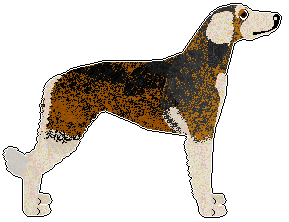
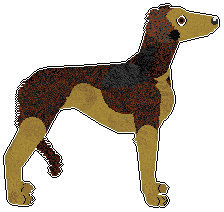
Domino is a newly identified pattern, but it appears in some of our most ancient breeds! Domino is sometimes referred to as grizzle in real life, but we will use the term domino at UKC to avoid confusion with the other type of grizzle. It appears somewhat like a dog with traditional tan points, but with more extended light markings and a more gradual transition from light to dark areas.
Domino is split into the following sections:
Base colour: The base colour of the main body.
Undercoat: Some dominoes are grizzled instead of solid, with the undercoat showing through the base colour, see below (optional).
Light Marking colour: The colour of the light markings. These markings are similar to tan points or urajiro markings.
Trim: The areas where the base colour and markings meet (optional).
The Pattern
The pattern is as follows:
Base colour +/- undercoat: On any area not listed below
Light markings:
- Minimum light markings: Lower muzzle, above the eyes, front of chest as two symmetrical spots, paws, and legs (lower and upper)
- Maximum light markings: Whole muzzle, surrounding the eyes and going up on the forehead, on the ears (whole or leaving the tips dark), paws and legs including shoulders/hips, running down the front of throat and chest, on the undersides of the body, on the tail (undersides or whole tail).
Trim: Where the base colour meets the light markings (such as upper legs, shoulder/hips, sides of body) a mingled furfile may be used to create a transitional change from light to dark.
Undercoat: Dominoes may use either only the base colour (solid) or show a lighter undercoat (grizzled). When grizzled, the undercoat is used as a ground colour, with the base colour as tipping on top. The tipping can be even all over, or lighter towards the trim/markings areas. The base colour may also be present as solid shading on the top of head, ears, back of neck, and along the spine and/or tail.
Note: Afghan hounds, due to their very long coat, can only show visible tipping along the more shorthaired spine/neck/head areas, while the undercoat/base coat flow together on the longhaired areas.
Allowed combinations:
The following are the allowed domino combinations. Please see the breed standard for which specific combinations are allowed in that breed.
| Name | Base Colour | Undercoat | Light Markings | Pigment |
|---|---|---|---|---|
| Black Domino |

|


|


|
Black |
| Grey Domino |


|


|
|
Black |
| Deer Domino |
|
|
|
Black |
| Liver Domino |
|
|
|
Liver |
Brindled domino
Domino may be brindled. If so, light markings remain untouched, while the rest of the dog is brindled using an allowed base/undercoat combination (e.g. / for a black domino).
Examples
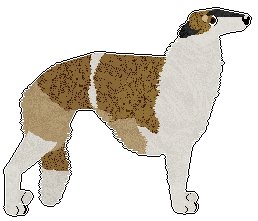
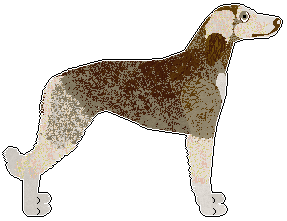
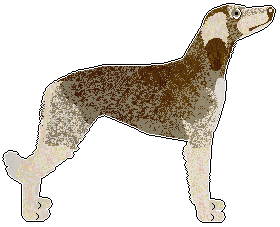
Note these examples are not the only possible cominations of markings/trim, they are just a couple of visual examples for the pattern.
 |
 |
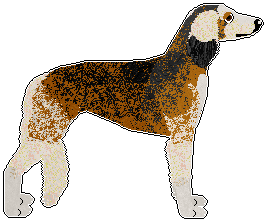 |
| A grizzled deer domino dog with a standard mask and white in the blanket pattern. (Please note that masking is not accepted in domino Borzois) | A grizzled liver domino dog with white in the irish spotting pattern. A grizzled/tipped furfile is used as a trim between the base/undercoat and the light marking colour | A grizzled black or deer domino dog with white in the irish spotting pattern. A grizzled/tipped furfile is used as a trim between the base/undercoat and the light marking colour |
 |
 |
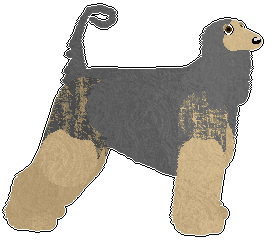 |
| A grizzled liver domino dog with white in the trim pattern. A grizzled/tipped furfile is used as a trim between the base/undercoat and the light marking colour | A grizzled black or deer domino dog with white in the trim pattern. A grizzled/tipped furfile is used as a trim between the base/undercoat and the light marking colour | A solid grey domino dog. A grizzled/tipped furfile is used as a trim between the base/undercoat and the light marking colour |
 |
||
| A grizzled black domino dog |
