Colourpoint
General
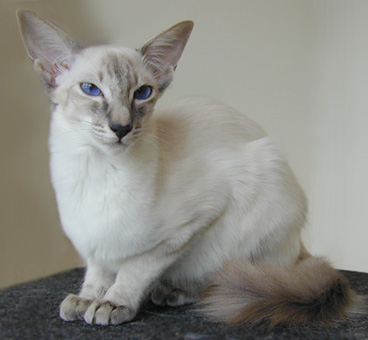
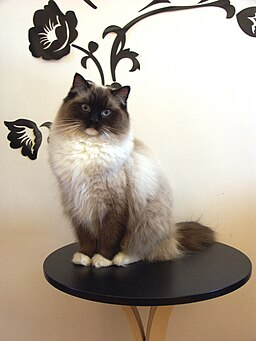
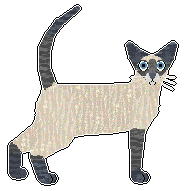
Colourpoint is the classic "Siamese" pattern with a pale body and dark legs, tail, ears, and face. This pattern is a form of albino and is heat-sensitive - the warm body remains pale while the coldest parts of the body are darker. These darker extremities are called "points".
Colourpoint can be combined with any pattern or pigment other than Burmese and/or Mink. Red-pigmented areas are more heavily affected than black-pigmented areas, appearing much lighter than their non-pointed equivalents.
The Point Pattern
All colourpoints follow the same pattern, which is as follows:
- Tail: Point coloured. The ball closest to the body may be the colour of the body
- Muzzle/mask:
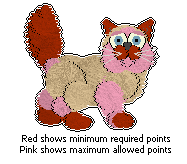
- Minimum point colour: Jowls, snout. White spotting may cover and hide parts or all of the mask
- Maximum point colour: Chin, jowls, snout, cheeks, with blaze or patch between the eyes to complete the mask. White spotting may cover and hide parts or all of the mask
- Ears: Always point coloured
- Feet:
- Minimum point colour: Forelegs up to but not including the wrist, hind legs up to but not including the hock. White spotting may cover and hide parts of the point pattern on the legs
- Maximum point colour: Forelegs up to and including the elbow, hind legs up to but not including the full knee. Paintballz may be placed on the knees and elbows to get a gradual effect. The exceptions are if the knee and shoulder are placed very high on the file - the point colour should not appear to continue from the legs up on the main body. White spotting may cover and hide parts of the point pattern on the legs
Eye colour - All colourpoints have 


Some breeds may also allow 
 - please refer to individual breed standards. Teal is not universally accepted in colourpoints.
Nose colour - Matches surrounding colour
Body Shading
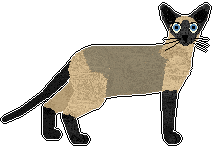
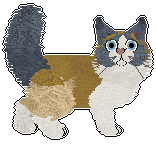
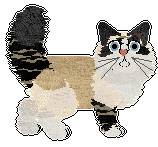
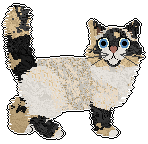
Shading is a mantle of darker colour along the shoulders, back, and upper body of colourpoint catz. It is most obvious in darker point colours, but can occur in any point colour. In non-strict colourpoints, shading can use one of the accepted body colours for that point colour and a related colour. In Strict colourpoints, the shading colour must be both a related and an accepted body colour for that combination.
When shading is present, at minimum, the darker shading colour can be present as a patch along the shoulders or along the spine, and at maximum covers the back, upper body, hips, shoulders, and back of the head/neck (leaving the lighter colour only on the front of the neck/chest and the belly).
Body shading is optional in all colourpoints
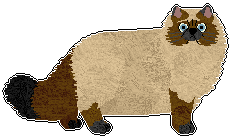
The following cat is an example of what shading looks like - please note that the cream colour represents the shading, and this examples shows the different degrees of the base (the lighter) body colour.
Please note: the head is not included in the minimum and maximum shading amounts outlined in this image - the head may be either colour, whether the darker shading colour or the lighter colour.
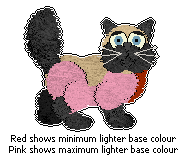
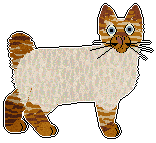
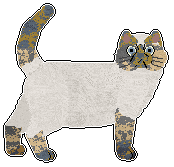
Examples of body shading in Colourpoint catz
Gradually Fading Points
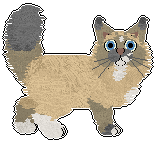
As points are affected by temperature, they may be darker at the outermost (coldest) end of the point and paler towards the warm body. This is represented in petz by using two point colours.
The darker (coldest) areas must be an acceptable colour for that point pattern. Minimum areas for the darker point colour are ear tips, toes/feet, last two tail balls, and the nose/snout, although it can be present on more of the points as well. There is no maximum amount of darker point colour. The rest of the present point colour can be a lighter shade or related colour.
Gradually fading points are optional in all colourpoints. Be wary when combining torbie with gradually fading points - too many colours may create a look that is very busy and that does not read as a torbie-patterned cat
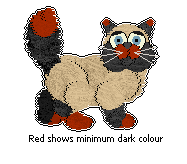
Examples of gradually fading points
Colourpoint Combinations
Colourpoint can be combined with any possible colour/pattern in cats, resulting in a wide variety of combinations. UKC allows the combinations listed below. For simplicity's sake, they have been split by pattern group.
For all, remember to check if that particular combination is allowed in the breed. Not all breeds allow all combinations. The points must always be darker than the body colour, meaning some discretion may be needed when picking colour combinations to use.
Strict
Some breed standards will list Colourpoint as being Strict for that breed. This means that clear contrast between point and body colour is preferred, and a lack of contrast where the line between point and body colour is unclear is faulted. When Strict Colourpoint is listed, it affects all varieties of colourpoint (i.e. Solid, Tabby, Tortie, Torbie and Inhibited points), although it is understood that even at its best contrast is lower in pale colours like shadeds/chinchillas and lighter cream tabby points etc.
Solid Point
Below are the accepted body and point combinations for solid colourpoints. The body colours for each point colour have been split into 'Strict' and 'Relaxed' columns - please consult the breed standards as to which type of colourpoint is accepted for that breed. If the standard doesn't specify either strict or relaxed, both are allowed.
| Name | Point Colours | Body Colours (Strict) | Body Colours (Relaxed) |
|---|---|---|---|
| Black (seal) point |


|


 are also accepted as shading colours, but not whole body colours are also accepted as shading colours, but not whole body colours
|


|
| Chocolate point |
|
|
is also allowed if points are not
|
| Cinnamon point |


|
|
is also allowed if points are not
|
| Blue point |


|

|
 is also allowed if points are not
|
| Lilac point |
|
|
is also allowed if points are not
is also allowed if points are
|
| Fawn point |
|
|
is also allowed if points are not
|
| Red (flame) point |

|
|
|
| Cream point |
|
is also allowed if points are not
|
is also allowed if points are not
|
Inhibited Points
Inhibited patterns are Smoke, Shaded and Chinchilla. These can appear on a gold (yellow/cream) or silver (white) base. In colourpoint, they follow these guidelines:
Smoke point
Body colour is , and points follow regular smoke combinations.
Shaded/Chinchilla point
Body colour is , and points follow regular shaded/chinchilla combinations. Body may show typical shaded/chinchilla tipping.
In golden shaded/chinchilla points the red areas are bleached to
Shaded/chinchilla points can be very difficult to distinguish from regular shaded/chinchilla due to the lightness of their pattern. In some cases eye colour may be the only way to identify the point pattern in these cats.
Tabby, Tortie, and Torbie Point
It is allowed to use fading and shading on torties, torbies and tabbies as you would on a solid point cat (following the same rules for a given area of fur), although note that excessive colours may disrupt the clarity of the point pattern. Below is more information of each of these patterns and how they combine with the colourpoint pattern
Tabby Point (Lynx Point)
Like normal tabbies, tabby colorpoints have dark stripes with a light base colour. In colorpoint cats, the points follow the same rules as normal tabbies. The body colour can either be a solid colour that corresponds to the stripe colour (e.g. a chocolate tabby point has chocolate stripes, and so can have any body colour associated with chocolate point cats), or stripes can be visible on the body.
When stripes are visible, there are two options for how they show up:- 1 - A transparent furfile over one of the body colours assocated with the stripe colour
- 2 - Two of the allowed body colours for the pigment/stripe colour, as tabby stripes
- solid , or
- transparent striped , or
- or base with striping
- base with striping
Tabby colour combinations and patterns are detailed in the tabby doc. Any tabby point combination that allows striping may have striping instead.
Tortie Point
Like normal tortoiseshell, tortie colorpoints have patches of a black-based color alongside patches of a red-based color. In colorpoint catz, this means catz combine black-based point and body colors with red-based point and body colors.
The table below details the allowed combinations for each colour. An allowed black-based point colour is mingled with an allowed red-based point colour on the points, and an allowed black-based body colour is mingled with an allowed red-based body colour on the body. A solid (not visibly tortie-patterned) body is allowed in all tortie points, and this body colour must be an accepted colour for both the black-based point colour and the red-based point colour. Relaxed colourpoint also allows all of the body colours listed under strict colourpoint.
| Name | Black-based point colour | Red-based point colour | Strict colourpoint body colour | Relaxed colourpoint – black-based body colour | Relaxed colourpoint – red-based body colour |
|---|---|---|---|---|---|
|
Seal (black) Tortie Point Black point & Red point |
|
|
Light with dark patches
Light with dark patches
with or patches
with patches
|
|
|
|
Chocolate Tortie Point Chocolate point & Red point |
|
|
Light with dark patches
Light with dark patches
with or patches
with patches
|
(only if points do not use )
|
|
|
Cinnamon Tortie Point Cinnamon point & Red point |
|
|
Light with dark patches
Light with dark patches
with or patches
with patches
|
|
|
|
Blue Tortie Point Blue point & Cream point |
|
(only if body does not use )
|
Light with dark patches
with patches
|
(only if points do not use )
|
|
|
Lilac Tortie Point Lilac point & Cream point |
|
(only if body does not use )
|
Light with dark patches
with patches
|
(only if points use )
(only if points do not use )
|
|
|
Fawn Tortie Point Fawn point & Cream point |
|
(only if body does not use )
|
Light with dark patches
with patches
|
(only if points do not use )
|
|
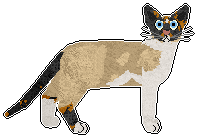
Above is a black (seal) tortie point that shows light with dark tortie patching on the body. To achieve a visible tortoiseshell pattern when using either 'light with dark patches' or 'light with dark patches', it is recommended to use colours at each end of the ranges, i.e 10 and 19, and 40 and 49
The distribution of tortie point patches on the points and body should follow the rules for regular tortoiseshell, which are outlined in the tortie doc.
Torbie Point (Tortie Lynx Point)
Torbie points follow a combination of the standards for tabby and tortie points. The colour tables below have been split into dense and dilute colours to ease reading and understanding. For details on accepted tabby colours and patterns, please consult the tabby doc, and details and examples of the torbie pattern can be found in the torbie doc.
Dense colours (black, chocolate & cinnamon)
All combinations are accepted in both strict and relaxed colourpoint. Any torbie point combination that allows stripes may have stripes instead.
| Name | Black-based point colour | Red-based point colour | Body colours |
| Black Torbie Point | with striping |
with striping
with striping
Light with dark striping
|
Solid
Transparent striped
with striping
with striping
Light with dark patches
Light with dark patches
Transparent striped patches with transparent striped patches
Transparent striped patches with transparent striped patches
Transparent striped patches with transparent striped patches
|
| Chocolate Torbie Point | with striping |
with striping
with striping
Light with dark striping
|
Solid
Transparent striped
with striping
with striping
Light with dark patches
Light with dark patches
Transparent striped patches with transparent striped patches
Transparent striped patches with transparent striped patches
Transparent striped patches with transparent striped patches
|
| Cinnamon Torbie Point | with striping
with striping
|
with striping
with striping
Light with dark striping
|
Solid
Transparent striped
with striping
with striping
Light with dark patches
Light with dark patches
Transparent striped patches with transparent striped patches
Transparent striped patches with transparent striped patches
Transparent striped patches with transparent striped patches
|
Dilute colours (blue, lilac & fawn)
All combinations are accepted in both strict and relaxed colourpoint.
UKC stewards have noticed that some of these dilute tabby combinations do not really mimic the real-life colours all that closely - however, for legacy reasons and due to the limitations of petz, they are still accepted without fault. You may be able to achieve more realistic colours using palettes - please refer to photographs of real cats in these colours/patterns to see what to aim for.
| Name | Black-based point colour | Red-based point colour | Body colours |
| Blue Torbie Point | with striping
with striping
Light with dark striping
Light with dark striping
|
with striping
with striping
Light with dark striping
Light with dark striping
|
Solid
Transparent striped
with striping
Light with dark patches
Transparent striped patches with transparent striped patches
|
| Lilac Torbie Point | with striping
with striping
Light with dark striping
Light with dark striping
|
with striping
with striping
Light with dark striping
Light with dark striping
|
Solid
Transparent striped
with striping
Light with dark patches
Transparent striped patches with transparent striped patches
|
| Fawn Torbie Point | with striping
with striping
Light with dark striping
|
with striping
with striping
Light with dark striping
Light with dark striping
|
Solid
Transparent striped
with striping
Light with dark patches
Transparent striped patches with transparent striped patches
|
Silver Tabby/Torbie Points
For all silver tabby/torbie points, allowed body colour is only or . Black silver tabby points also allow . Any silver tabby/torbie point combination that allows stripes may have stripes instead.
Bleaching
The colourpoint pattern has a tendency to bleach red areas, therefore some additional combinations are allowed in tabby/tortie/torbie points that are not seen in usual tabbies/torties/torbies. Bleaching affects both the points and body, so if you choose to use a bleached version of red, it should replace all of that red on both the main body and the points. The point pattern should still be relatively clear - the body colour must be lighter than or the same as the lightest colour used on the points
Tabby points- Cinnamon tabby points also allow transparent tabby on
- Red tabby points also allow with striping or with striping
- Cream tabby points also allow with striping
- For all combinations that normally use or , you may use instead on tortie/torbie points
- For torties/torbies that normally use or , you may use
Examples
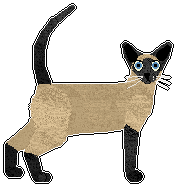
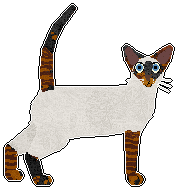
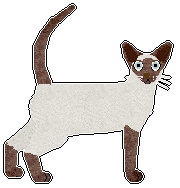
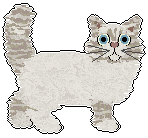
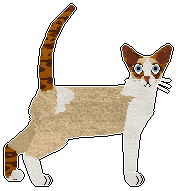
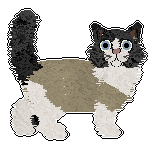
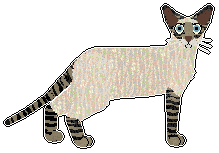
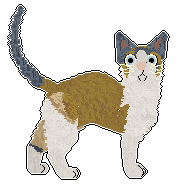
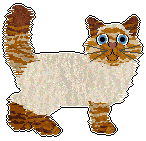
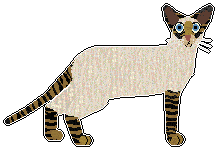
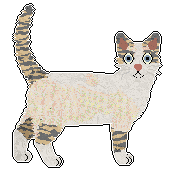
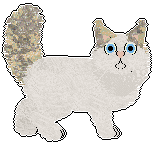
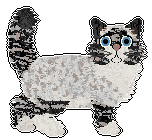
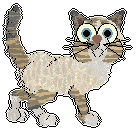
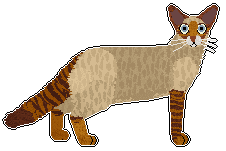
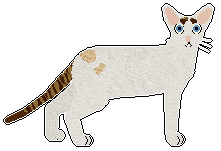
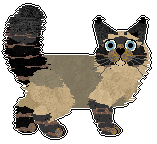
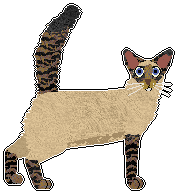
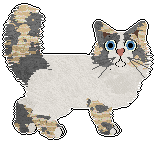
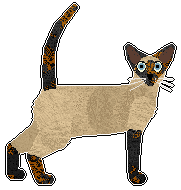
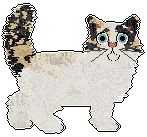
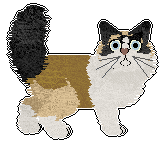
Below is a gallery of colorpoint catz in combination with various patterns. Many more combinations than these are acceptable, this is just to provide some visual guidance to the text above.
 |
 |
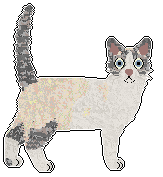 |
| A black (seal) point | A black (seal) tortie point | A blue silver tabby point with white in the bicolour pattern |
 |
 |
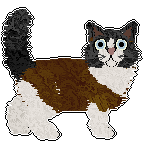 |
| A chocolate smoke point | A lilac or fawn silver point with white in the tuxedo pattern | A black (seal) point with white in the bicolour pattern |
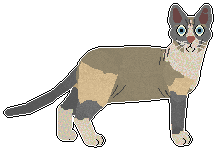 |
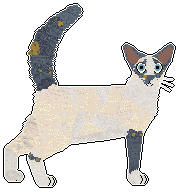 |
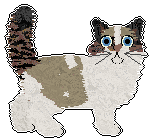 |
| A blue point with body shading and white in the tuxedo pattern | A blue tortie point with white in the tuxedo pattern | A black (brown) tabby point with white in the bicolour pattern |
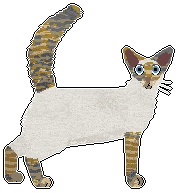 |
 |
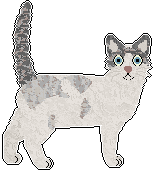 |
| A blue torbie point | A red tabby point with white in the bicolour pattern | A lilac tabby point with white in the bicolour pattern |
 |
 |
|
| A black (seal) point with white in the bicolour pattern | A black (brown) tabby point | A blue point with body shading and white in the tuxedo pattern |
 |
 |
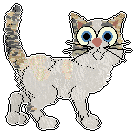 |
| A blue point with body shading and white in the bicolour pattern | A red tabby point with gradually fading points | A lilac or fawn torbie point with white in the bicolour pattern |
 |
 |
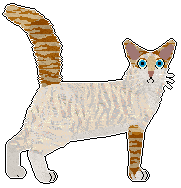 |
| A black (brown) tabby point | A blue golden tabby point with white in the bicolour pattern | A red tabby point with white in the tuxedo pattern |
|
 |
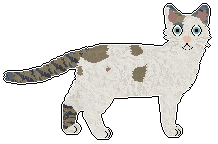 |
| A blue point with gradually fading points and white in the mitted pattern | A black (seal) tortie smoke point with bleached red areas and white in the van pattern | A blue tabby point with white in the harlequin pattern |
 |
 |
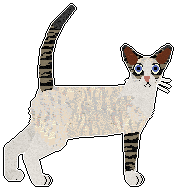 |
| A black silver tabby point with white in the tuxedo pattern | A blue tabby point with gradually fading points, and white in the tuxedo pattern | A black (brown) tabby point with white in the tuxedo pattern |
 |
 |
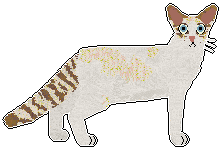 |
| A red tabby point | A chocolate tabby point with white in the van pattern | A cinnamon silver tabby point with white in the harlequin pattern |
 |
 |
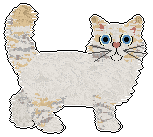 |
| A black heavy tabby point with body shading | A black tabby point | A lilac or fawn silver torbie point with white in the tuxedo pattern |
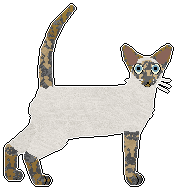 |
|
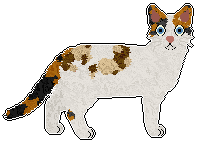 |
| A blue tortie point with gradually fading points | A black (seal) tortie point with body shading, bleached red areas and white in the tuxedo pattern | A black (seal) tortie point with white in the bicolour pattern |
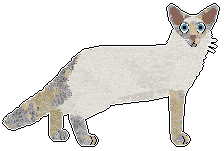 |
 |
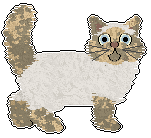 |
| A blue tortie smoke point | A blue tortie point with white in the tuxedo pattern | A lilac or fawn tortie point |
 |
 |
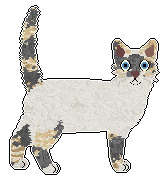 |
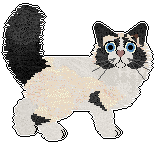
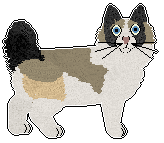
| A black tortie point | A black (seal) tortie point with body shading, bleached red areas and white in the bicolour pattern | A blue tortie point with white in the mitted pattern |
 |
 |
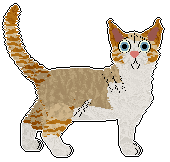 |
| A black (seal) point with white in the bicolour pattern | A black (seal) point with body shading and white in the bicolour pattern | A red tabby point with white in the tuxedo pattern |
 |
|
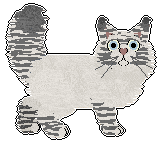 |
| A blue tabby point with gradually fading points | A black (seal) point with body shading | A blue silver tabby with white in the trim pattern |
 |
|
|
| A black (seal) point with body shading and white in the tuxedo pattern | A black (brown) tabby point with body shading and white in the tuxedo pattern |