Coat: Amber
General
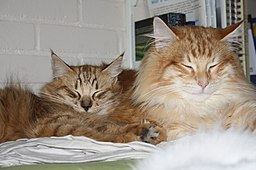
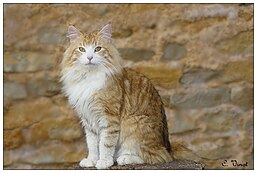
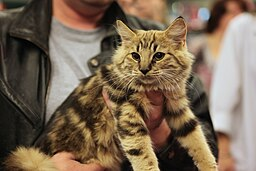
Amber is a newly recognized pattern, so far only found in Norwegian Forest Cats. It's recognized by a golden glow in the coat, which intensifies with age, gradually replacing black/blue areas with an amber shade. A common trait in many amber cats is a mask of dark colour surrounding the nose. Because the fading of the dark areas happen at different speed rates in different cats, combined with the long fur which can distort patterns, the end result is a look that can vary quite a bit.
While Amber can genetically be combined with any pigment type and any pattern, the Norwegian Forest Cat only accepts black and blue based colours (as chocolate & cinnamon do not exist in the breed). Black-based ambers are called simply 'Amber' while blue-based are called 'Light Amber'.
Masks
Masks: A common trait in amber cats is the dark nose combined with a small facial mask. In all patterns (except catz with pink noses due to white spotting) the nose is preferred to be black/blue depending on pigment type. A mask is optional but preferred. It ranges from a black patch above the nostrils, to covering the whole snout and/or jowls, or anything inbetween.
Tabby
Amber tabbies follow normal Tabby striping guidelines, but their base and stripe colours are exchanged for amber tabby colours. The amount replaced varies, and to make it easier to understand we have split the amber pattern into three categories, called cold amber, lukewarm amber, and warm amber. Any of the varieties may be used.
Cold amber: As for a regular tabby, but the base colour may be replaced with an amber base colour. If it uses a regular tabby base colour, the nose mask may be the only way to tell a cat of this type apart from a regular tabby.
Lukewarm amber: A cat that fits inbetween cold and warm. The cat appears as a regular tabby, but with areas that use an amber combination (base and stripes). These areas must be on at least the front of neck/chest and undersides, but may also include the sides of the body, paws/legs, face (except muzzle area, which should remain dark), and tail.
Warm amber: As for a regular tabby, but with all of the colour (base and stripes) replaced by an allowed amber combination. It's typical and allowed for warm ambers to retain a bit of dark (regular tabby) striping on the tailtip and/or along the spine and/or face.
Accepted Combinations:
Note that these are just the replacement colours. Cold ambers still make use of the regular tabby combinations as well.
Black tabby (Amber tabby):
Stripes may be 


Base colour may be 

Blue tabby (Light Amber tabby):
Stripes may be
Base colour may be 

is also an accepted body colour if the stripes are not
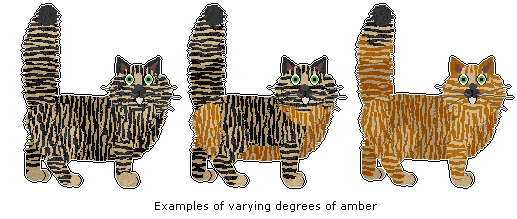
Left to Right: Cold amber - Lukewarm amber - Warm amber
Silver tabbies:
Striping colours are as above, but body colour is or
Smoke
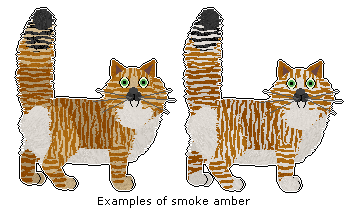
Smoke amber looks like regular Amber/Light Amber, but with a lighter undercoat. This can be represented by colouring the most longhaired areas of the cat (ruff, undersides, leg feathers, backside of tail where applicable) or by replacing all of the base colour with
Body markings may be blurry or replaced by solid base colour in this pattern.
Torbie
As this pattern normally appears in tabbied form, we only include torbie, not tortie, under the accepted patterns. A torbie amber follows regular torbie guidelines, but replacing the black/blue areas as listed under Tabby above. The non-amber areas (ie the red/cream tabby areas) follow usual red/cream guidelines and are not affected by the Amber gene, but the base colour should match.
Shaded/Chinchilla
As for regular shaded/chinchilla, but exchange the black/blue areas for the replacement striping colours listed under Amber Tabby, further up in the doc.
